Breaking News
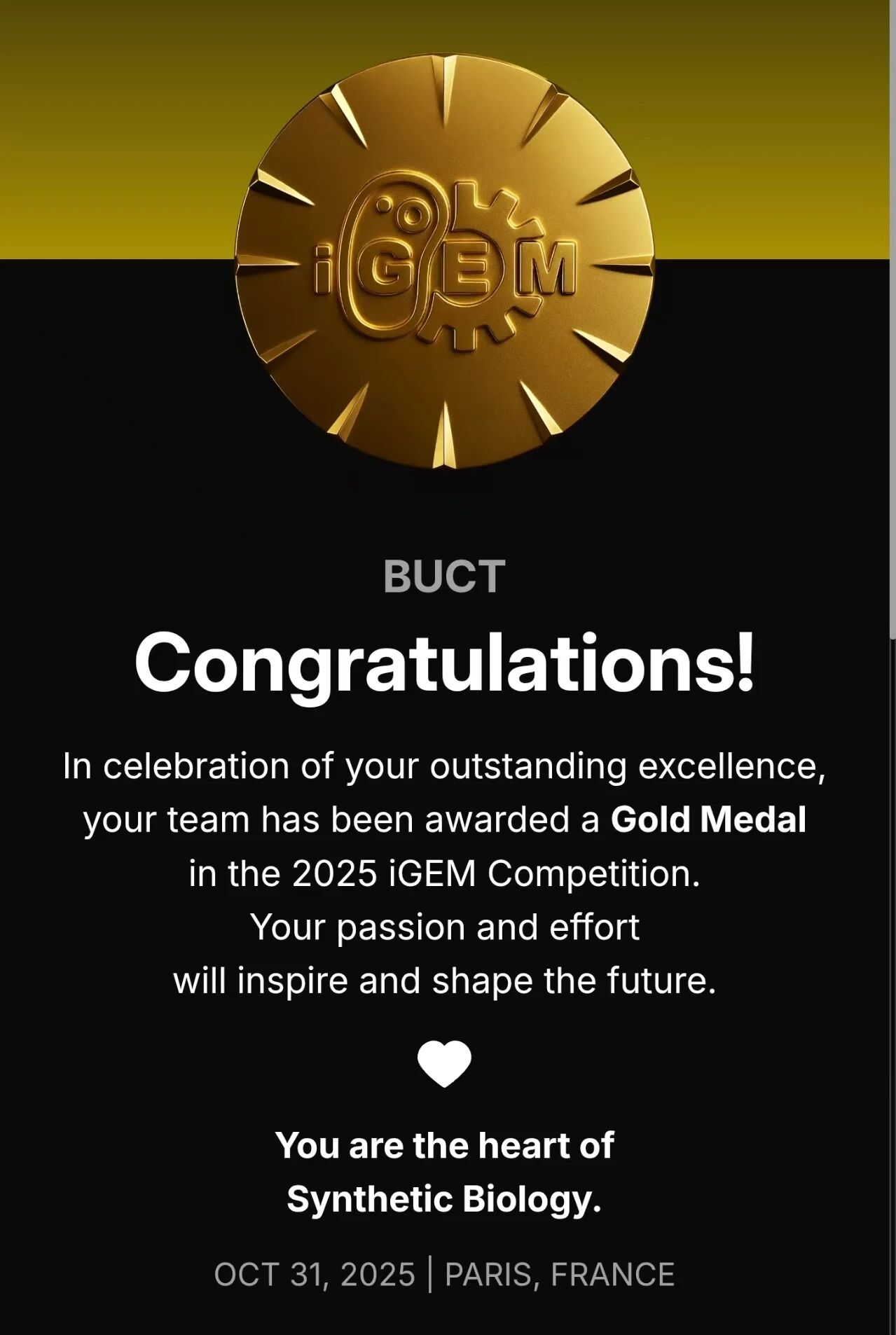
At 1:35 AM Beijing time on November 1, the results of the 2025 International Genetically Engineered Machine Competition (iGEM)—often called the Olympics of synthetic biology—were announced. The iGEM2025-BUCT team from Beijing University of Chemical Technology traveled to France to showcase the spirit of BUCT students to the world. They secured a Gold Award while also receiving nominations for the Best Education Special Award and the Best Bioremediation Project Award!
Awards
Competition Overview
The International Genetically Engineered Machine Competition (iGEM), initiated by the Massachusetts Institute of Technology, is the premier international synthetic biology contest. It garners significant attention from academic journals like Nature and Science, as well as the industrial sector. iGEM is a multidisciplinary international science competition centered on synthetic biology, encompassing biology, mathematics, and computer science. Teams with diverse backgrounds must utilize standard biobricks to construct genetic circuits, develop effective mathematical models, and achieve prediction, manipulation, and measurement of sophisticated artificial biosystems to complete the challenge. iGEM stands as the most prestigious competition in the global synthetic biology arena! As an international competition dedicated to promoting synthetic biology and fostering academic exchange among young scholars, iGEM annually attracts teams from top universities worldwide, including Harvard University, Massachusetts Institute of Technology, Peking University, and Tsinghua University. The iGEM competition serves not only as a valuable platform for academic exchange with peers from domestic and international institutions but also cultivates students' comprehensive competencies and global perspectives, while enhancing the international reputation and influence of participating universities.
Team Introduction
In 2025, under the guidance of five faculty members—Prof. Zhang Yifei, Prof. Shen Xiaolin, Prof. Wang Jia, Prof. Sun Xinxiao, and Prof. Li Zhengjun—the team conducted thorough research and in-depth studies on marine plastic pollution and its prevention. Twenty members from the School of Life Science and Technology, School of Chemical Engineering, School of Mathematics and Physics, School of Economics and Management, School of Humanities and Law, School of International Education, and École Curie d'Ingénieurs formed the iGEM 2025-BUCT team—POLYGONE—comprising experimental, modeling, wiki, HP, and graphic design groups.
Project Overview
Polyester plastics (PET, PBAT, PLA, etc.) persist in marine environments, forming harmful microplastics. To address both source prevention and end-of-pipe treatment, the team identified a marine polyester hydrolase “polygonase” through marine polyester-degrading enzyme discovery, protein sequence redesign, and AI-driven mutation screening. Combining enzyme immobilization technology with plastic thermal processing, they developed an enzyme-containing plastic film capable of accelerated degradation in simulated seawater. The team enhanced bacterial PET degradation and TPA detection sensitivity by surface display technology in E. coli, anchoring adhesion proteins and polyester hydrolase. Future work will focus on optimizing enzyme preparation methods and TPA biosensors, while evaluating environmental fate, safety, and regulatory pathways.
Highlights & Breakthrough Moments
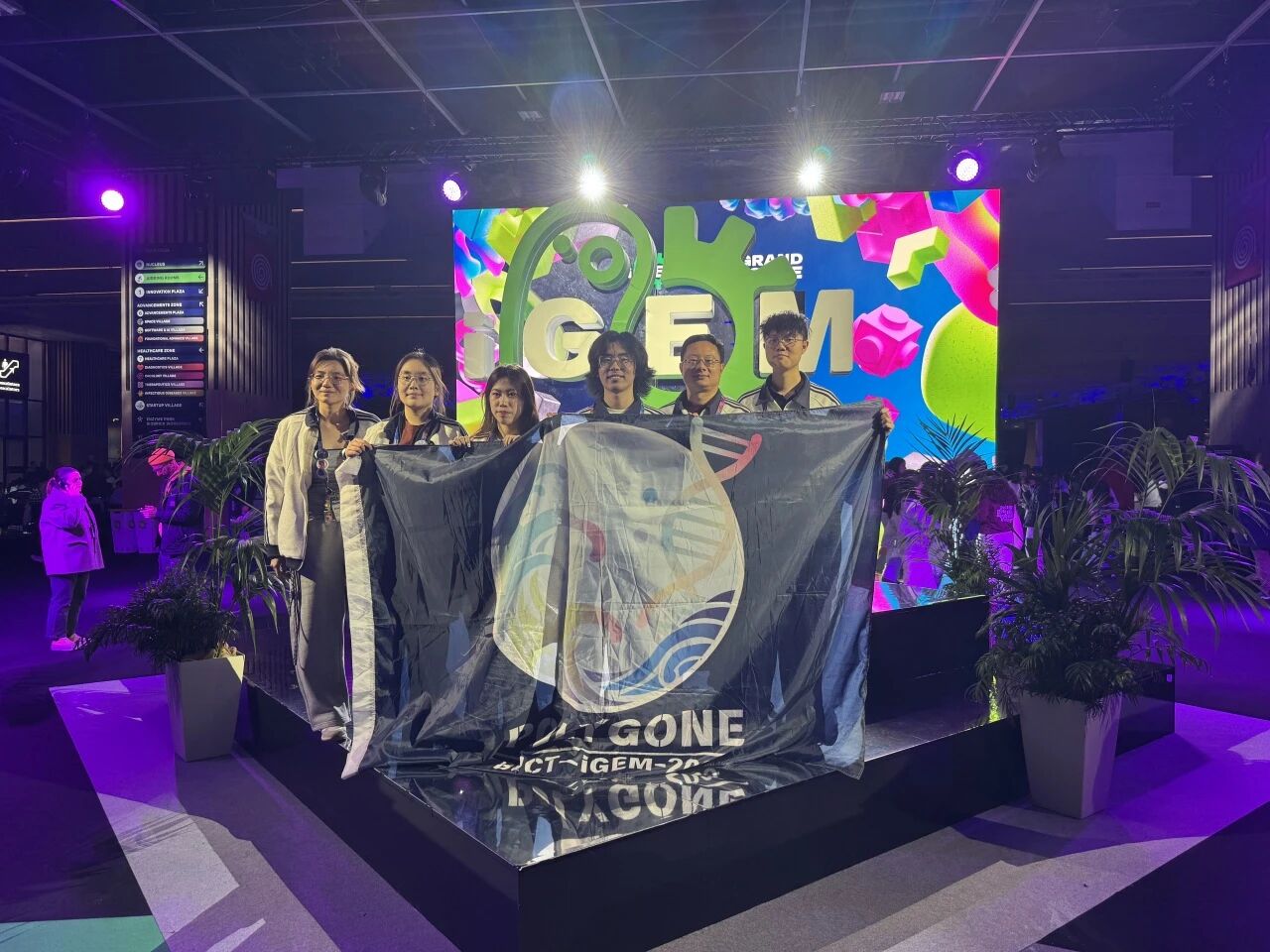
On October 26, 2025, under the guidance of Professor Zhang Yifei, team captain Li Junbin, laboratory members Zhou Xingxing and Wu Changye, and HP group members Wang Zihan and Wang Chenhan traveled to Paris to participate in the Grand Jamboree. They engaged in exchanges and competitions with over 8,000 iGEMers from more than 400 teams worldwide.
Booth Presentation:
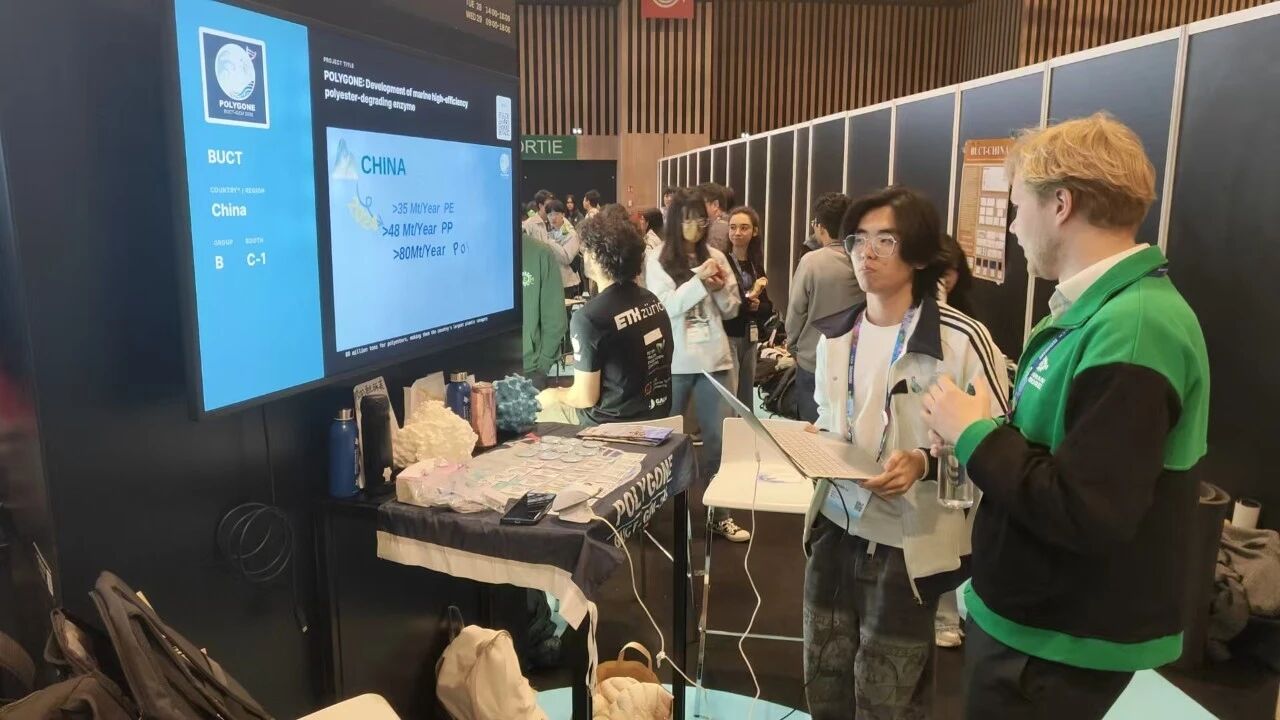
At the exhibition booth, team members meticulously arranged the project display area, providing detailed introductions to the project's background, objectives, and achievements for global audiences and competing teams. The rich interactive exhibits allowed more people to understand the appeal of synthetic biology, and team members also gained valuable exchanges and feedback!
Judge Session:
During the judging session, team members provided detailed responses to the judges' questions and engaged in in-depth discussions about the project's technical details and future development direction. They successfully demonstrated the project's feasibility and unique value, earning the judges' affirmation and support!
Team Members
Principal Investigators
Zhang Yifei, Shen Xiaolin, Wang Jia, Sun Xinxiao, Li Zhengjun
Advisors
Yu Linwei, Muhammud Ali
Student Leaders
Li Junbin, Liu Li, Li Zihao, Long Zhihua
Students
Experimental Team: Li Junbin, Wu Changye, Zhou Xingxing, Yang Xinyan, Tang Zengrong
HP Team: Li Zihao, Wang Zihan, Wang Chenhan, Long Kangrui, Jiang Xinyuan
Modeling Team: Ma Boyuan, Wang Mengmeng, LAL AAYUSH ATISHAY
Wiki Team: Li Pingwei, Wu Chengxuan
Art Design Team: Liu Li, Li Tuantuan, Zhou Yuxin, Lin Zhengyang
Manuscript: Li Junbin, Yu Linwei
Review: Zhang Yifei