Fu Jinyu1# Shang Qingqing1# Yang Jiaming1 Su Xin2* Shi Shuobo1,2*
(Beijing University of Chemical Technology. 1. Advanced Innovation Center for Soft Matter Science and Engineering; 2. School of Life Sciences and Technology, Beijing 100029)
Research Background: Nucleic acid detection technologies are critical for infectious disease control and early diagnosis. However, traditional methods such as qPCR rely on sophisticated equipment and specialized expertise, making them unsuitable for rapid on-site testing. Emerging CRISPR-based detection technologies, while highly specific, still require pre-amplification of targets, limiting their portability and point-of-care potential. Therefore, developing amplification-free, highly sensitive, and user-friendly molecular diagnostic methods is crucial for enhancing public health emergency response capabilities and supporting rapid testing at grassroots and field levels. To achieve rapid, highly sensitive detection of target RNA molecules, this study combined the CRISPR/Cas13 system with total internal reflection fluorescence microscopy (TIRF) to develop an amplification-free single-molecule detection technology. This approach offers high sensitivity, strong specificity, and eliminates the need for additional nucleic acid amplification steps, providing novel insights for subsequent rapid diagnostic method development with potential practical applications.
Key Highlights: This study innovatively integrates the CRISPR/Cas13 system with TIRF to develop a nucleic acid amplification-free single-molecule detection technology, with primary highlights as follows: (1) By mutating the Cas13 protein, a dCas13 protein was obtained that retains binding activity but lacks cleavage function, enabling specific capture of target RNA without inducing non-specific degradation. (2) TIRF enables direct single-molecule detection of RNA-dCas13-sgRNA complexes with a detection limit as low as 1 pmol/L, representing a 1000-fold improvement over the ancillary cleavage activity of the wild-type protein. (3) This method effectively distinguishes common SARS-CoV-2 spike gene variants (e.g., N501Y, D614G), demonstrating excellent single-nucleotide resolution. The “amplification-free + single-molecule imaging” design in this study eliminates the amplification step in traditional CRISPR assays, shortening detection time while reducing operational complexity and contamination risks. This approach provides novel insights for developing next-generation portable, highly sensitive molecular diagnostic platforms.
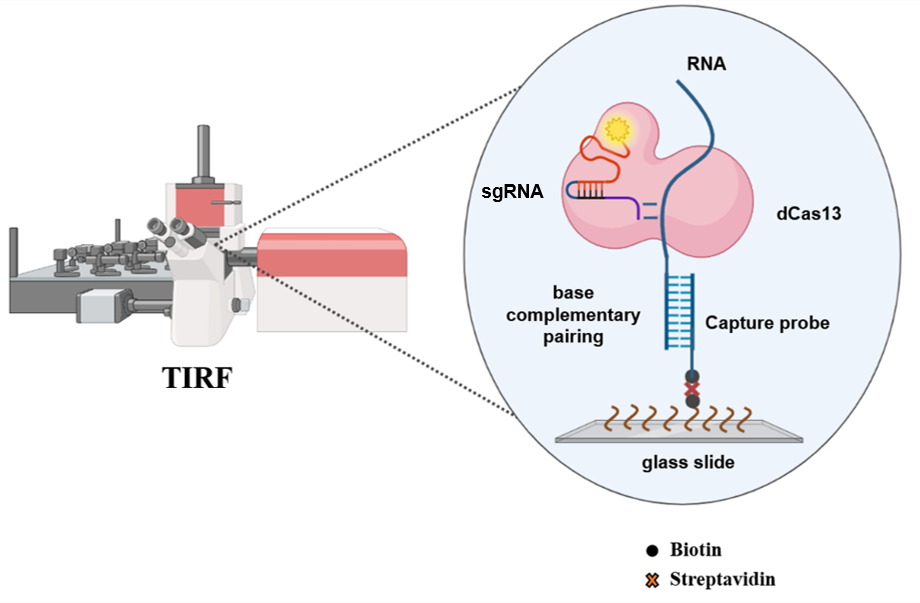
Schematic Diagram of Single-Molecule Detection Principle Based on the CRISPR/Cas13 System and TIRF