
On December 18, the 2025 Bio-Manufacturing Conference opened in Chongqing. At the conference, Tan Tianwei, Academician of the Chinese Academy of Engineering and President of Beijing University of Chemical Technology, delivered a speech titled “Developing Bio-Manufacturing to Support the Implementation of the ‘Dual Carbon’ Goals.”
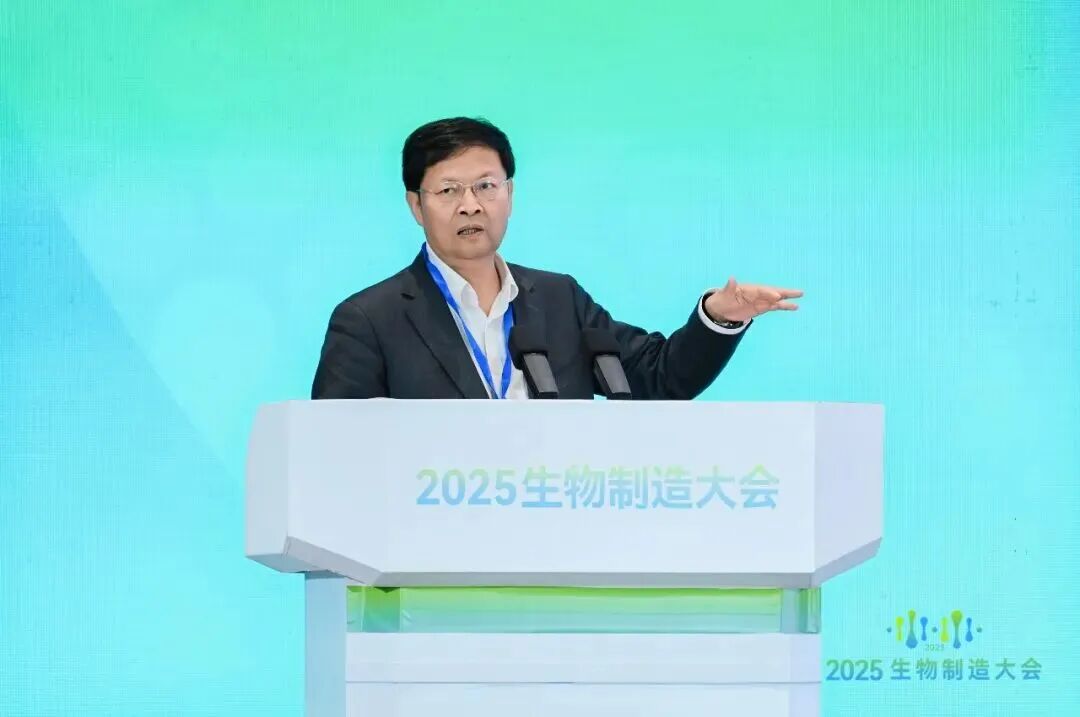
Tan Tianwei explained that biomanufacturing is a product processing method characterized by utilizing biological entities such as enzymes, microbial cells, and multicellular tissues, combined with process engineering principles to achieve industrial production. Biomanufactured products span multiple fields including chemicals, materials, food, pharmaceuticals, and vaccines. Compared to traditional manufacturing, biomanufacturing offers three key advantages: First, precision and efficiency—leveraging the inherent properties of biological entities to synthesize complex molecules with low energy consumption and no additional negative energy output, achieving accuracy far surpassing existing technologies. Second, renewable raw materials—most inputs are renewable biomass. Third, environmental friendliness—all reactions occur under ambient temperature and pressure, eliminating safety hazards like explosions or corrosion.
From fermenting kimchi and brewing beer to the industrial production of modern penicillin, biomanufacturing technology has continuously evolved. Tan Tianwei outlined key milestones in the field: Pasteur's discovery of microorganisms in 1857; the industrial production of penicillin in 1943; the establishment of molecular biology in 1953; breakthroughs in synthetic biology in 2010; Nobel Prizes awarded for directed evolution in 2018 and gene editing in 2020.
Driven by global demand for green and low-carbon solutions, biomaking's market potential is gaining significant attention. “Seventy percent of global manufacturing products can be produced through biomaking,” Tan stated. " Tan Tianwei stated. Currently, the global biomaterials market is valued at nearly $8 trillion, and by the end of this century, it is projected to reach $30 trillion, accounting for one-third of global manufacturing output. As a key enabler for achieving China's dual carbon goals, biomaterials can reduce carbon dioxide emissions by 2.5 to 3 billion tons annually through process substitution alone, playing a vital role in aviation fuel alternatives, low-carbon transformation of plastic products, and agricultural byproduct production.
Biomanufacturing has now become a strategic high ground in international competition. Tan Tianwei noted that in 2023, the United States released the “Biotechnology and Biomanufacturing Goals Act,” setting clear phased targets: replacing 90% of existing plastics with bio-based alternatives within 20 years, and meeting at least 30% of U.S. chemical demand through sustainable and cost-effective biomanufacturing methods within the same timeframe. The EU has legislated to prioritize biomaterials manufacturing, with European facilities now doubling those in the U.S. India's sector is expanding rapidly, having grown 13-fold over the past decade.
Tan Tianwei emphasized that to compete internationally, China's biomedicine industry must focus on two key directions: First, strengthening independent innovation to overcome bottleneck technologies like bio-based chemical materials—recently achieving pilot-scale breakthroughs in bio-manufacturing ethylene glycol. Second, accelerating the integration of artificial intelligence and biomedicine by advancing frontier technologies such as digital cell factories, while addressing deficiencies in foundational databases and software R&D.