
In China, the overall 5-year survival rate of patients with hepatocellular carcinoma (HCC) remains below 20%, indicating an extremely poor prognosis. In-depth dissection of the molecular mechanisms underlying hepatocarcinogenesis and progression, and the identification of targetable metabolic vulnerabilities, represent key directions for current breakthroughs in HCC research and therapy.
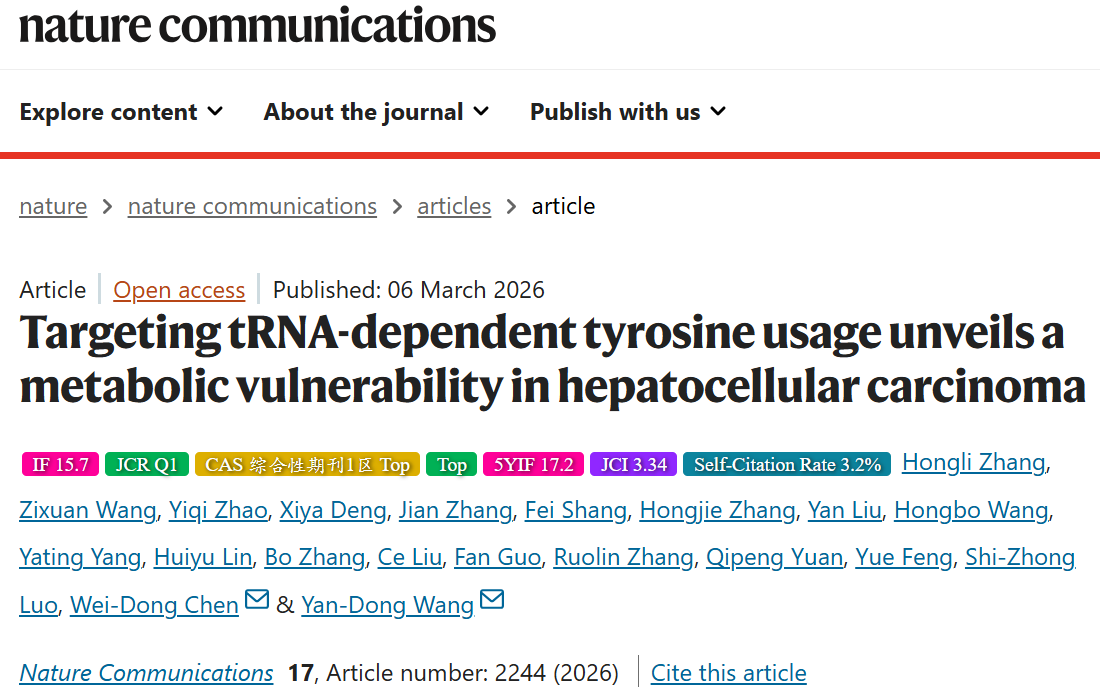
On March 6, 2026, the research team led by Professor Yandong Wang at Beijing University of Chemical Technology and Professor Weidong Chen at Inner Mongolia Medical University published an online research paper in Nature Communications (IF: 15.7) entitled “Targeting tRNA-dependent tyrosine usage unveils a metabolic vulnerability in hepatocellular carcinoma”. For the first time, from the perspective of translational metabolic reprogramming, this study revealed the abnormal dependence of hepatocellular carcinoma on tyrosine utilization and proposed a novel therapeutic strategy termed restriction of tyrosine translational availability (RTTA).
Taking amino acid metabolic reprogramming as the entry point, the study demonstrated that tumor cells do not merely “consume” amino acids, but actively reshape their utilization patterns, achieving precise regulation between catabolism and protein synthesis. Using metabolomic analysis, the research team discovered a key phenomenon: tyrosine levels were markedly decreased in HCC tissues and negatively correlated with tumor progression. This “tyrosine paradox” implies that tyrosine is not deficient, but is efficiently “consumed” by tumor cells.
Further investigations revealed that HCC cells upregulate tyrosine transport and inhibit its catabolism, thereby redirecting tyrosine preferentially toward protein translation rather than conventional metabolic pathways. In this process, the oncogene MYC plays a central regulatory role:
MYC transcriptionally activates the aminoacyl-tRNA synthetase YARS1, enhancing the supply of tRNA-Tyr and thereby driving tyrosine-dependent translational reprogramming.
A direct consequence of this mechanism is that tumor cells become highly dependent on the tyrosine-tRNA system to maintain the translation of essential proteins, forming a “metabolic bottleneck” that can be precisely targeted.
At the functional level, the study found that restricting tyrosine translational availability (RTTA) selectively inhibits a subset of tyrosine-rich key proteins, including:
- NDUFB8, a core subunit of mitochondrial complex I (affecting energy metabolism)
- SCD1, a key enzyme in lipid metabolism (regulating lipid composition and antioxidant capacity)
Impaired translation of these proteins leads to mitochondrial dysfunction and accumulated lipid peroxidation, ultimately inducing ferroptosis in tumor cells.
Notably, this strategy exhibits remarkable selectivity:
Because tumor cells rely far more heavily on protein synthesis than normal cells, RTTA exerts a much stronger inhibitory effect on tumors while exerting relatively limited effects on normal tissues.
For therapeutic translation, the study proposed and validated multiple intervention strategies:
- Tyrosine-restricted diet: significantly suppresses tumor growth and prolongs survival
- Tyrosine degradation by TAL enzymes: effectively reduces tumor burden in vivo
- YARS1 inhibitors (e.g., tyrosinol): directly block the tRNA aminoacylation process
Meanwhile, CRISPR screening further revealed that RTTA exhibits synthetic lethal interactions with pathways including GPX4, SLC7A11, and BCL2, and confirmed its significant synergistic anti-tumor effects with clinical drugs such as sorafenib and venetoclax.
Collectively, the most important breakthrough of this study is:
It proposes, for the first time, a new paradigm of “tyrosine shift from metabolism to translation” in HCC, and establishes that the MYC-YARS1 axis-driven tRNA-dependent translational reprogramming is a core dependency for tumor survival.
On this basis, the study proposes that restricting tyrosine translational availability (RTTA) can simultaneously disrupt energy metabolism and lipid metabolism, induce ferroptosis, and thereby achieve potent anti-tumor effects.
This work not only reveals a novel layer of metabolic reprogramming in HCC, but also provides a highly promising direction for cancer therapy: targeting translational metabolic dependencies may represent an important new strategy following conventional metabolic inhibition and immunotherapy.