
On December 23, 2025, Xinyu Tian, Jianyu Long, and other researchers from Beijing University of Chemical Technology published a research article entitled "Synergistic Enhancement of Thermal Stability and Activity of Glycolaldehyde Synthase via Computer-Aided Design and Mechanistic Analysis" in the Journal of Agricultural and Food Chemistry.
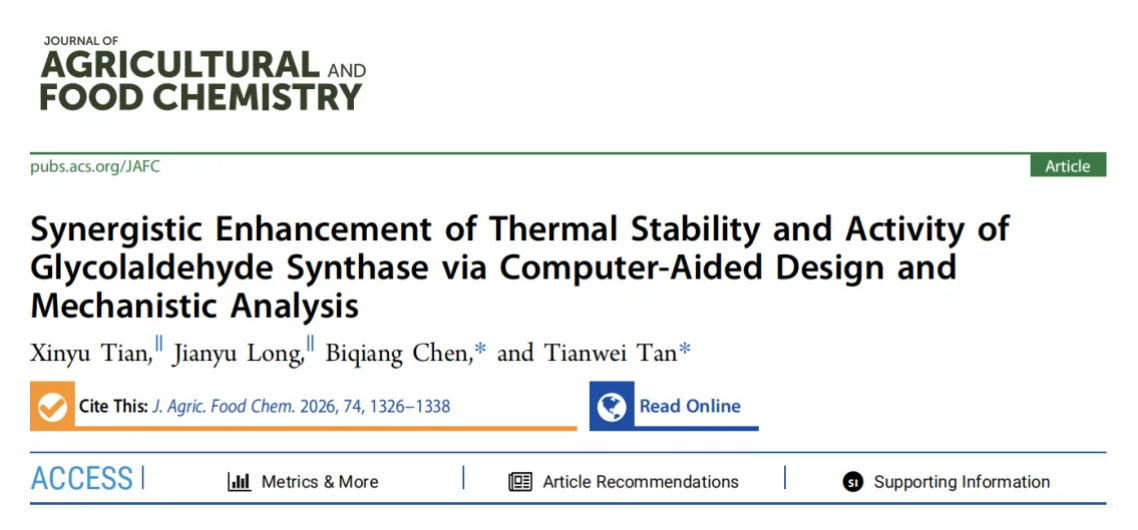
This study successfully developed a glycolaldehyde synthase variant GALS M5 with synergistically enhanced thermostability and catalytic activity via computer-aided rational design, providing a high-performance biocatalyst for efficient bioconversion of C1 resources.
1. Research Background and Challenges
Glycolaldehyde synthase (GALS) is a key biocatalyst for C1 compound utilization, capable of converting formaldehyde into high-value chemicals. However, its poor thermostability severely limits industrial applications. The previously obtained high-activity variant GALS M3 (catalytic efficiency = 153.3 M⁻¹·s⁻¹) provided the optimization foundation for this study.
2. Core Design Strategy
Based on the structure of GALS M3, computational tools including FireProt were used to predict and screen flexible regions. Two rounds of systematic protein engineering were performed to achieve simultaneous improvements in activity and stability.
3. Key Achievements
- Optimal variant GALS M5: Constructed as GALS M3 A381P/K290P. While maintaining high catalytic activity (initial activity = 2204.55 U/g), it exhibited significantly improved thermostability (Tm = 63 °C), representing the best performing GALS reported to date.
- Thermoactivation behavior: Variant GALS M3 S61A showed unique thermoactivation, with 1.4 fold higher activity after incubation at 50 °C for 3 hours.
- High substrate tolerance: GALS M5 maintained efficient catalysis even at 100 mM formaldehyde, producing 20.7 mM glycolaldehyde with a conversion rate of 41.5%.
4. Mechanistic Insights
- Enhanced thermostability: Molecular dynamics simulations confirmed that the mutations strengthened loop rigidity in GALS M5, effectively preventing structural unfolding at high temperatures (RMSD stabilized at approximately 0.165 nm at 55 °C).
- Thermoactivation mechanism: For GALS M3 S61A, moderate temperatures induced dynamic conformational rearrangement of the main chain, increasing the population of catalytically favorable conformations. This improved substrate affinity (lower Km) and apparent activity, rather than occurring via conventional unfolding.
5. Research Significance
This study validates the effectiveness of computer-aided design in synergistically enhancing enzyme activity and thermostability. As a highly efficient and thermotolerant biocatalyst, GALS M5 lays a foundation for the conversion of CO₂-derived carbon sources into high-value-added chemicals. Future research will focus on overcoming product inhibition, constructing integrated biosynthetic systems, and extending the design principles of thermoactivated enzymes.