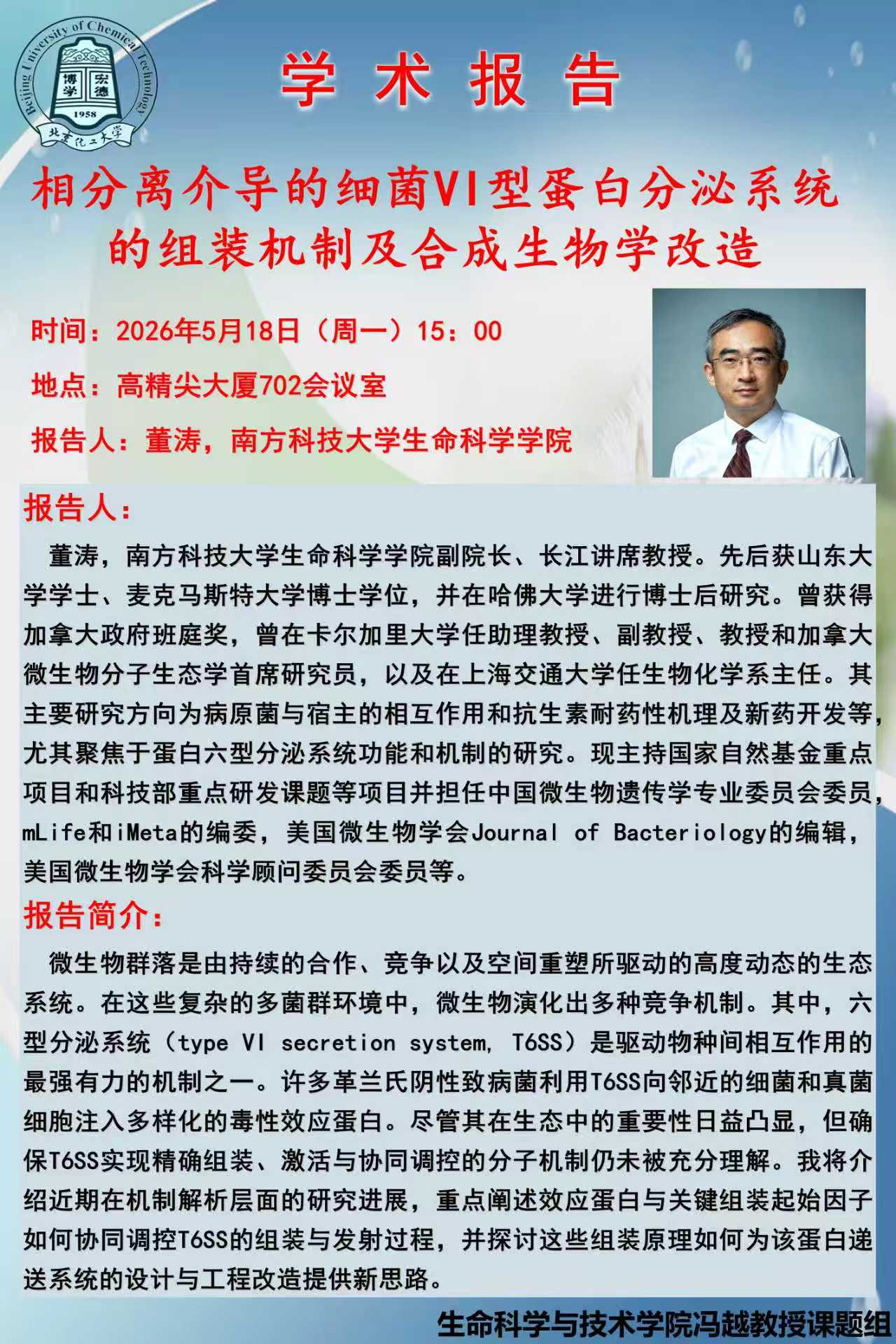
Lecture Details
- Time: 15:00, Monday, May 18, 2026
- Venue: Room 702, High-Tech Innovation Building
- Speaker: Prof. Tao Dong, School of Life Sciences, Southern University of Science and Technology
Speaker Biography
Prof. Tao Dong
Vice Dean of the School of Life Sciences, Southern University of Science and Technology
Yangtze River Distinguished Professor
Prof. Dong received his B.Sc. from Shandong University, Ph.D. from McMaster University, and completed postdoctoral research at Harvard University. He is a recipient of the Government of Canada Award. He previously held positions as Assistant Professor, Associate Professor, and Professor at the University of Calgary, and served as the Canada Chair in Microbial Molecular Ecology. He also served as Head of the Department of Biological Chemistry at Shanghai Jiao Tong University.
His main research interests include pathogen-host interactions, antibiotic resistance mechanisms, and novel drug development, with a particular focus on the function and mechanism of the Type VI secretion system (T6SS). He currently presides over key projects of the National Natural Science Foundation of China and key R&D projects of the Ministry of Science and Technology. He also serves as a member of the Chinese Society for Microbial Genetics, an editorial board member of mLife and iMeta, an editor of the American Society for Microbiology’s Journal of Bacteriology, and a member of the ASM Science Advisory Committee, among other roles.
Abstract
Microbial communities are highly dynamic ecosystems driven by continuous cooperation, competition, and spatial remodeling. In these complex multi-species environments, microorganisms have evolved diverse competitive mechanisms. Among them, the Type VI secretion system (T6SS) is one of the most powerful mechanisms driving interspecies interactions. Many Gram-negative pathogens use the T6SS to inject diverse toxic effector proteins into neighboring bacterial and fungal cells.
Despite its growing ecological importance, the molecular mechanisms that ensure precise assembly, activation, and coordinated regulation of the T6SS remain poorly understood. This lecture will present recent advances in mechanistic dissection, focusing on how effector proteins and key assembly initiators coordinately regulate the assembly and firing processes of the T6SS. It will also discuss how these assembly principles provide new insights for the design and engineering of this protein delivery system.