
Key Highlights
A research team led by Prof. Huiyu Liu at Beijing University of Chemical Technology has developed an in-situ oxygen vacancy (Vo)-engineered Pd-TiO₂ sonocatalyst with spatially separated dual active sites. This design addresses two major bottlenecks in conventional sonodynamic therapy (SDT): sluggish charge transfer and low reactive oxygen species (ROS) production, enabling highly effective and safe tumor ablation under ultrasound irradiation.
Background: The Bottleneck of Sonodynamic Therapy
Sonodynamic therapy (SDT) is a non-invasive cancer treatment that relies on ultrasound-activated sonosensitizers to generate ROS and kill tumor cells. However, its clinical translation is severely limited by:
High electron-hole recombination rates and low charge transfer efficiency, leading to insufficient ROS production
Ambiguous active sites, making it difficult to precisely regulate catalytic pathways
Core Innovation: Oxygen Vacancy-Driven Dual-Site Synergistic Catalysis
The Pd-TiO₂ sonocatalyst leverages oxygen vacancies to construct spatially separated dual active sites, optimizing charge dynamics and amplifying ROS production:
Oxygen Vacancies as "Electron Pumps"
Ultrasound-induced oxygen vacancies activate the Pd–O–Ti electron transfer channel, driving efficient electron migration from TiO₂ to Pd sites and suppressing charge recombination.
Dual-Site Coordinated ROS Generation
Pd Sites: Enriched with electrons, serving as the primary active centers for singlet oxygen (¹O₂) production
Oxygen Vacancy Sites: Reconstruct Ti 3d orbitals to enhance coupling with H₂O, promoting hydroxyl radical (•OH) formation
Reduced Activation Energy Barrier
The dual-site configuration enables simultaneous and efficient production of both ¹O₂ and •OH, significantly boosting the overall ROS yield and tumor-killing efficacy.
Validation: Excellent Performance In Vitro and In Vivo
In Vitro: The optimized Pd-TiO₂ demonstrated remarkable tumor cell apoptosis under ultrasound irradiation, with significantly improved cytotoxicity compared to traditional catalysts.
In Vivo: The catalyst achieved effective tumor ablation in xenograft mouse models with negligible side effects, confirming both its therapeutic efficacy and biosafety.
Significance and Outlook
Novel Strategy: This work proposes a new paradigm for designing dual-site sonocatalysts via oxygen vacancy engineering, offering a universal approach to enhance ROS generation.
Clinical Translation: The design overcomes key limitations of SDT, advancing the development of non-invasive cancer therapies.
Broad Applicability: The dual-site synergistic concept can be extended to other semiconductor-based catalytic systems for diverse biomedical applications.
Paper Information
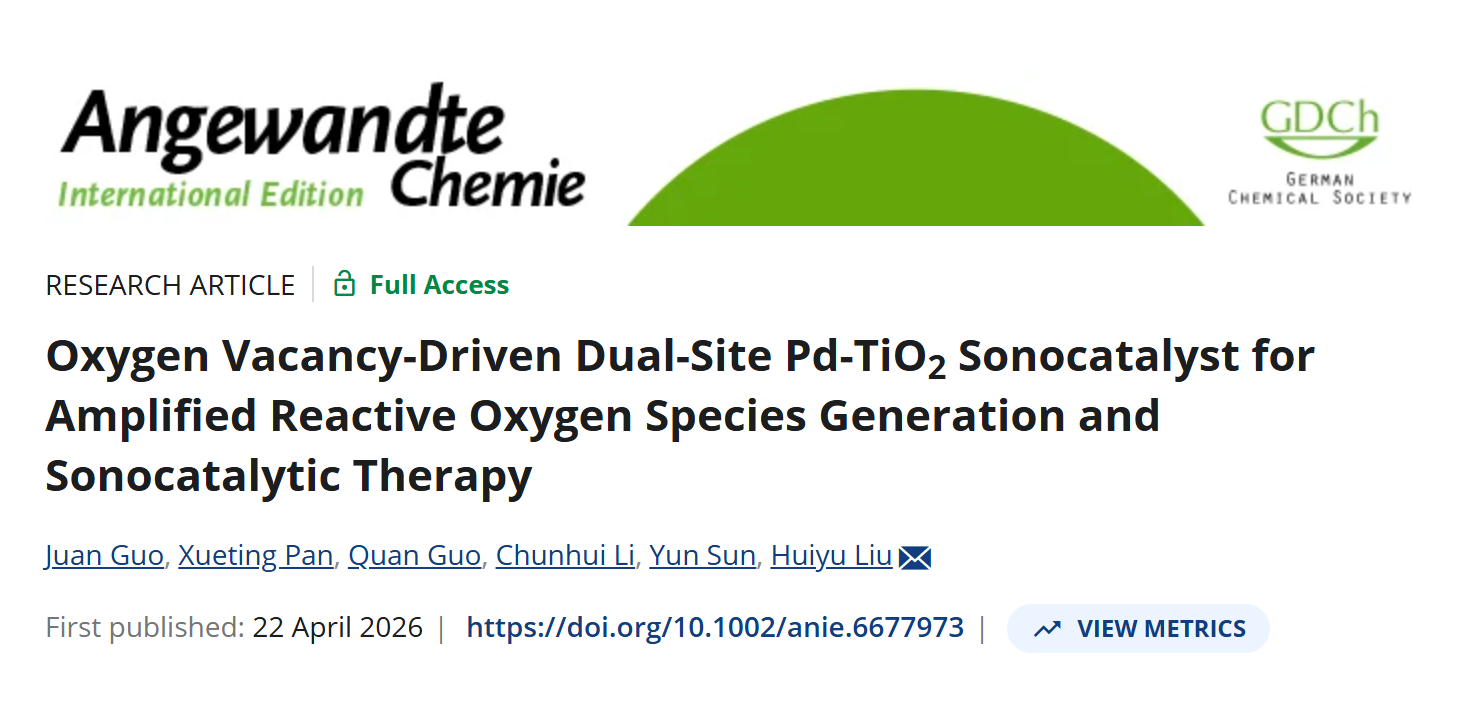
Title: Oxygen Vacancy-Driven Dual-Site Pd-TiO₂ Sonocatalyst for Amplified Reactive Oxygen Species Generation and Sonocatalytic Therapy
Authors: Juan Guo, Xueting Pan, Quan Guo, Chunhui Li, Yun Sun, Huiyu Liu*
Journal: Angewandte Chemie International Edition
Publication Date: April 22, 2026
DOI: 10.1002/anie.6677973