
Key Highlights
A research team led by Prof. Tianwei Tan, Prof. Biqiang Chen, and Dr. Ziheng Cui at Beijing University of Chemical Technology has developed an integrated strategy combining rational enzyme engineering and a onestep pretreatment process, enabling efficient, scalable depolymerization of postconsumer PET waste under mild conditions. This work addresses key bottlenecks in enzymatic PET recycling and paves the way for industrialscale, circular plastic economy solutions.
Background: The Challenge of PET Waste Recycling
Polyethylene terephthalate (PET) is one of the most widely used plastics globally, yet its chemical inertness and complex waste matrices severely limit traditional recycling routes. Enzymatic depolymerization is a promising ecofriendly alternative, but faces major hurdles:
Low enzymatic activity and stability under industrial conditions
Inability to handle contaminated, colored, or amorphous PET waste
High costs and low scalability of existing pretreatment methods
Core Innovation: Integrated Enzyme Engineering + OneStep Pretreatment
The team developed a dualpronged approach to overcome these challenges:
1. Rational Enzyme Engineering for Enhanced Catalysis
Structureguided mutagenesis was applied to optimize PETase variants, significantly improving substrate affinity, thermal stability, and resistance to product inhibition.
The engineered enzyme showed robust activity against both crystalline and amorphous PET, including realworld postconsumer waste streams.
2. Mild OneStep Pretreatment
A lowcost, environmentally benign pretreatment was developed to disrupt PET’s crystalline structure without harsh chemicals or high temperatures.
This step drastically reduced the material’s recalcitrance, boosting enzymatic accessibility and depolymerization rates by over 10fold compared to untreated PET.
3. Integrated Process for Scalability
Combining the engineered enzyme with the onestep pretreatment enabled continuous PET depolymerization at high solid loadings.
The system achieved >90% conversion of various PET waste types (bottles, films, fibers) within 48 hours, producing pure terephthalic acid (TPA) monomers suitable for repolymerization.
Performance & Validation
Versatility: The integrated system efficiently processed diverse PET waste streams, including colored, multilayered, and contaminated materials.
Scalability: Pilotscale trials demonstrated stable performance at kilogram scale, confirming the method’s industrial feasibility.
Circularity: The recovered TPA monomers met polymergrade purity standards, enabling closedloop recycling of new PET products.
Significance & Outlook
Technological Breakthrough: This work provides a practical, scalable solution for enzymatic PET recycling by addressing both enzyme performance and feedstock recalcitrance.
Environmental Impact: The process operates under mild conditions, avoiding toxic chemicals and reducing carbon footprints compared to conventional recycling.
Future Directions: The strategy can be extended to other polyester plastics, supporting broader applications in sustainable plastic waste management.
Paper Information
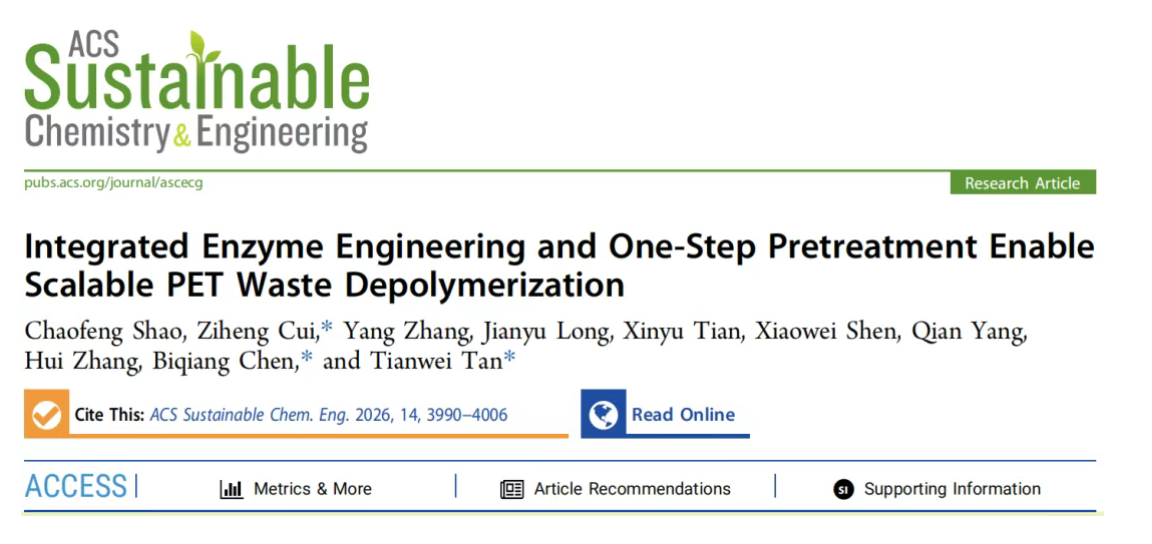
Title: Integrated Enzyme Engineering and OneStep Pretreatment Enable Scalable PET Waste Depolymerization
Authors: Chaofeng Shao, Ziheng Cui, Yang Zhang, Jianyu Long, Xinyu Tian, Xiaowei Shen, Qian Yang, Hui Zhang, Biqiang Chen, and Tianwei Tan
Journal: ACS Sustainable Chemistry & Engineering
Publication Year: 2026
Volume/Issue: 14, 3990–4006
DOI: 10.1021/acssuschemeng.5c08765