
Key Highlights
A research team led by Prof. Jia Wang at Beijing University of Chemical Technology has successfully constructed biosynthetic pathways in Escherichia coli for the production of two highvalue pyridine alkaloids: nicotinic acid (niacin) and trigonelline. This work provides a sustainable, microbial fermentation route to these industrially and nutritionally important compounds, offering an ecofriendly alternative to traditional chemical synthesis.
Background: The Demand for Sustainable Pyridine Alkaloid Production
Nicotinic acid (vitamin B3) and trigonelline are widely used in food, pharmaceutical, and cosmetic industries, with applications ranging from nutritional supplements to plant growth regulators. However, conventional production relies on:
Energyintensive chemical synthesis using petroleumderived feedstocks
Lowyield plant extraction methods with high environmental footprints
Microbial biosynthesis offers a promising green alternative, but requires the design and optimization of efficient biosynthetic pathways in host strains like E. coli.
Core Innovation: De Novo Pathway Construction in E. coli
The team systematically designed and validated biosynthetic routes for both compounds in E. coli:
1. Nicotinic Acid Biosynthetic Pathway
A de novo pathway was constructed by introducing key enzymes involved in pyridine ring formation and oxidation.
Through gene selection, expression tuning, and cofactor balancing, the engineered strain achieved significant nicotinic acid titers under shakeflask conditions.
2. Trigonelline Biosynthetic Pathway
Building on the nicotinic acid platform, the team introduced a nicotinate Nmethyltransferase to convert nicotinic acid into trigonelline.
The resulting pathway demonstrated high specificity and efficiency, enabling direct production of trigonelline from simple carbon sources.
3. Strain Optimization & Process Validation
Metabolic bottlenecks were identified and relieved via precursor pool enhancement and pathway balancing.
Fedbatch fermentation trials confirmed scalable production, laying the groundwork for industrial application.
Performance & Significance
DualCompound Production: The platform enables the synthesis of both nicotinic acid and trigonelline in a single microbial host, offering process flexibility.
Green & Sustainable: The biosynthesis route avoids harsh chemicals and high temperatures, aligning with circular economy principles.
Broad Applications: The engineered strains can serve as a chassis for producing other pyridine alkaloids, expanding the scope of microbial pyridine compound production.
Outlook
This work establishes a foundational platform for the sustainable bioproduction of nicotinic acid and trigonelline, addressing key limitations of traditional manufacturing methods. The pathway design and optimization strategies also provide a blueprint for engineering microbial hosts to produce other highvalue pyridinederived compounds.
Paper Information
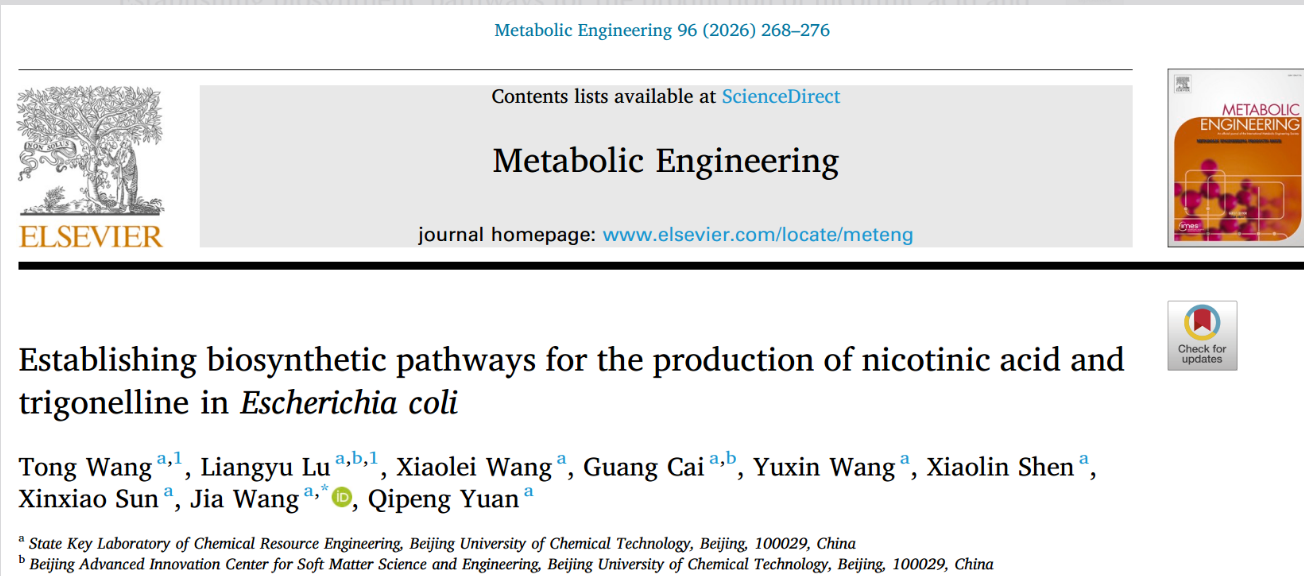
Title: Establishing biosynthetic pathways for the production of nicotinic acid and trigonelline in Escherichia coli
Authors: Tong Wang, Liangyu Lu, Xiaolei Wang, Guang Cai, Yuxin Wang, Xiaolin Shen, Xinxiao Sun, Jia Wang, Qipeng Yuan
Journal: Metabolic Engineering
Publication Year: 2026
Volume/Issue: 96, 268–276
Affiliations: State Key Laboratory of Chemical Resource Engineering, Beijing University of Chemical Technology; Beijing Advanced Innovation Center for Soft Matter Science and Engineering, Beijing University of Chemical Technology