
Key Highlights
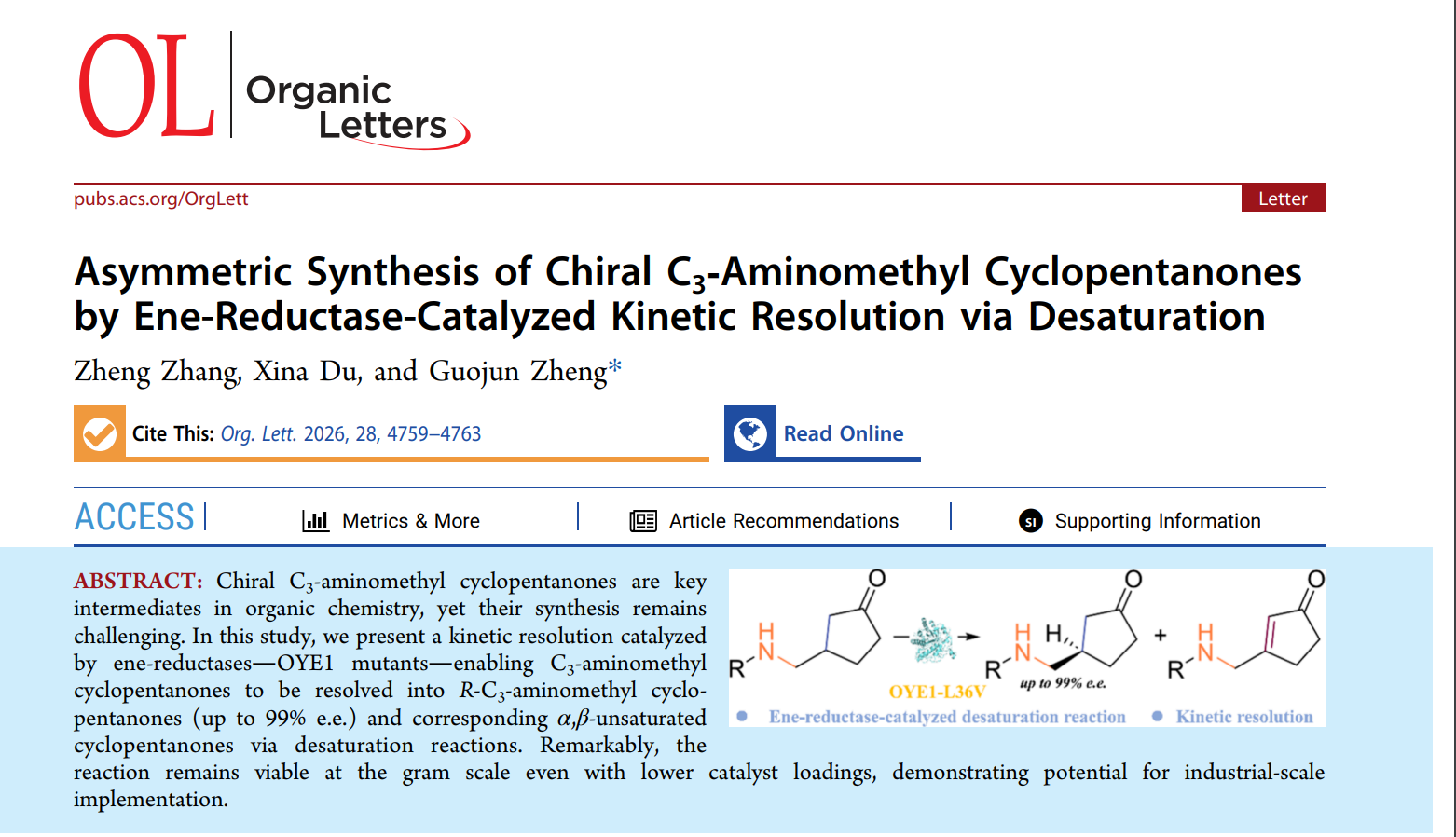
A research team led by Prof. Guojun Zheng at Beijing University of Chemical Technology has developed a novel kinetic resolution strategy catalyzed by engineered ene-reductases (OYE1 mutants). This method enables the efficient asymmetric synthesis of chiral C₃-aminomethyl cyclopentanones, a class of key organic intermediates, with excellent enantiomeric excess (up to 99% e.e.) and gram-scale synthetic potential.
Background: The Synthetic Challenge of Chiral Cyclopentanones
Chiral C₃-aminomethyl cyclopentanones are versatile building blocks for pharmaceuticals, agrochemicals, and natural product synthesis. However, their preparation has long been a synthetic challenge due to:
- Difficulty in controlling stereochemistry at the C₃ position
- Harsh conditions and low enantioselectivity in traditional chemical methods
- Lack of scalable, biocatalytic approaches for these specific structures
Core Innovation: Ene-Reductase-Catalyzed Kinetic Resolution via Desaturation
The team leveraged engineered ene-reductases to develop a unique desaturation-based kinetic resolution process:
1. Enzyme Engineering for Stereoselectivity
- The team identified and optimized the OYE1-L36V mutant, which exhibits exceptional stereoselectivity for the desaturation of racemic C₃-aminomethyl cyclopentanones.
- The enzyme selectively converts one enantiomer of the substrate into the corresponding α,β-unsaturated cyclopentenone, leaving the other enantiomer (R-configured) untouched.
2. Highly Selective Resolution
- The reaction achieves kinetic resolution with enantiomeric excess (e.e.) values up to 99%, delivering pure R-C₃-aminomethyl cyclopentanones and their unsaturated counterparts in high optical purity.
- The process proceeds under mild, environmentally friendly conditions, avoiding toxic reagents and metal catalysts.
3. Scalable & Industrial-Ready
- The reaction remains highly efficient at the gram scale, even with reduced catalyst loadings, demonstrating strong potential for industrial-scale implementation.
- The strategy provides a straightforward route to both chiral saturated and unsaturated cyclopentanone derivatives from a single racemic starting material.
Significance & Impact
- Synthetic Breakthrough: This work presents the first ene-reductase-catalyzed desaturation reaction for the kinetic resolution of cyclopentanone derivatives, offering a new tool for asymmetric synthesis.
- Biocatalytic Expansion: The method expands the synthetic utility of ene-reductases beyond their typical reduction reactions, showcasing their potential in oxidative desaturation processes.
- Industrial Relevance: The gram-scale feasibility and low catalyst loading highlight the process’s promise for large-scale production of high-value chiral intermediates.
Paper Information
- Title: Asymmetric Synthesis of Chiral C₃-Aminomethyl Cyclopentanones by Ene-Reductase-Catalyzed Kinetic Resolution via Desaturation
- Authors: Zheng Zhang, Xina Du, Guojun Zheng
- Journal: ACS Organic Letters
- DOI: 10.1021/acs.orglett.6c00828