
Li Xiaoyang's research group at Beijing University of Chemical Technology, in collaboration with Ge Jun's team at Tsinghua University, published a research paper titled "Assembling a single active pocket from enzyme and metal modules for simultaneously catalyzing oxidation-reduction cascades" in Nature Communications. This study reports an innovative strategy for constructing an "enzyme-metal hybrid active pocket" that uses metal catalytic modules to edit enzyme active pockets. It proposes a new cascade catalytic process of "one binding, two reactions," enabling simultaneous catalysis of multi-step reactions at a single site, eliminating diffusion and recombination between intermediates across multiple catalytic modules, and solving the diffusion control problem in cascade reactions. By utilizing the electron transfer effect between enzymes and metal catalytic modules, the enzyme achieves efficient low-concentration conversion of various non-natural substrates.
Enzyme-chemical cascade reactions combine the advantages of enzyme catalysis and metal catalysis, enabling "non-natural" conversion, and represent a cutting-edge research direction in biocatalysis. However, diffusion resistance between reaction intermediates between different catalytic modules is the main factor limiting cascade efficiency. Inspired by substrate channels in multi-enzyme complexes in nature, integrating metal modules and enzymes into a single catalyst can reduce intermediate diffusion and improve efficiency through proximity effects. In this study, the researchers proposed a further idea: precisely assemble multiple catalytic modules to form a single active pocket with spatial structure, allowing substrates to combine and continuously complete multi-step reactions, with the intermediate almost no diffusion out of the active pocket, theoretically eliminating diffusion resistance and greatly improving cascade efficiency.
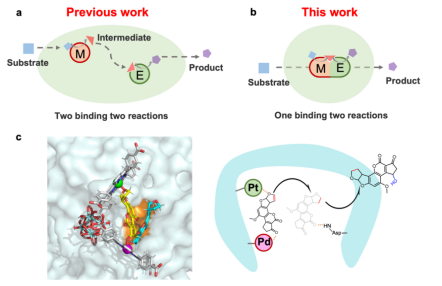
Figure 1. Enzyme-metal hybridization active sites catalyze multi-step cascade reactions
This study uses metal-organic frameworks (MOFs), utilizing Zr clusters co-co-coordinating with metal atomic elements and enzyme catalytic modules to self-assemble and construct highly stable enzyme-metal hybrid active sites. This enables simultaneous catalytic transfer hydrogenation and oxidation reactions at the same site, and for the first time proposes a new catalytic process for parallel multi-step reactions at a single site: the substrate completes multi-step cascade within a single active site, eliminating the diffusion process of intermediates. Through density functional theory (DFT) calculations and electron paramagnetic resonance (ESR), the enhanced electron transfer mechanism between laccase at active sites and Pt/Pd diatomic elements was revealed, solving the original speed limiting problem of electron transfer from the T1 copper site to the T2/T3 trinuclear copper cluster. The synergistic interaction and strong electron transfer between laccase and Pt/Pd dual-atom elements within the active site broadened the catalytic substrate types and range of laccase substrates, enabling efficient directed conversion of five low-concentration non-natural substrate mycotoxins (with a catalytic efficiency of 0 for the original enzyme (enzyme-metal hybridization active site catalytic efficiency 100%).
Original article link
https://www.nature.com/articles/s41467-026-72061-z
Text and images | Li Xiaoyang
Typesetting | Li Xiaoyang
Reviewed by | Jia Guanglian, Wang Xing, Cao Hui