
Multiplex nucleic acid testing is an important foundation for the diagnosis of infectious diseases, tumor marker analysis, and spatial omics research. However, traditional fluorescence multiplex detection often relies on multiple colors, complex spectral resolution, and precise calibration. The more channels there are, the easier it is for color crossing, background interference, and decoding errors to accumulate.
Is it possible to use only one fluorescent color and simultaneously resolve multiple nucleic acid targets using spatial positioning? Su Xin's team at Beijing University of Chemical Technology has provided a new answer: instead of 'stuffing target information' into color, they write it into the spatial positions of the microspheres.
Research highlight: Making "position" a new fluorescent channel
Recently, a team led by Su Xin and Wang Shihui from the School of Life Sciences at Beijing University of Chemical Technology published a research paper titled "Spatial fluorescence barcode by transiently luminescent DNA beads" in Nature Communications. This study proposes a spatial fluorescence barcode (SFB) strategy based on transiently luminescent DNA beads (TLDBs), providing a new solution for high-throughput, low-crosstalk, and reusable multiplex nucleic acid detection.
The core idea of this system can be summarized as "monochrome readout, spatial coding, enzymatic reset." The research team fixed the Y-shaped DNA probe onto the surface of polystyrene microspheres coated with streptavidin. When the target nucleic acid appears, the target removes the quenching strand through a chain displacement reaction, causing the Cy5 fluorescence on the microsphere surface to briefly illuminate; Subsequently, nuclease in the system degrades the bound target, causing the quenching strand to rehybridize, the microsphere returns to the dark state, and proceeds to the next round of testing.
By sequentially introducing different targets and recording the microsphere emission positions, the system can establish monochromatic space fluorescence barcode codes (mSFBC). In detecting unknown samples, simply by spatially co-positioning and comparing the positions of the light-emitting microspheres with the codebook, it is possible to identify which nucleic acid targets are present in the sample.
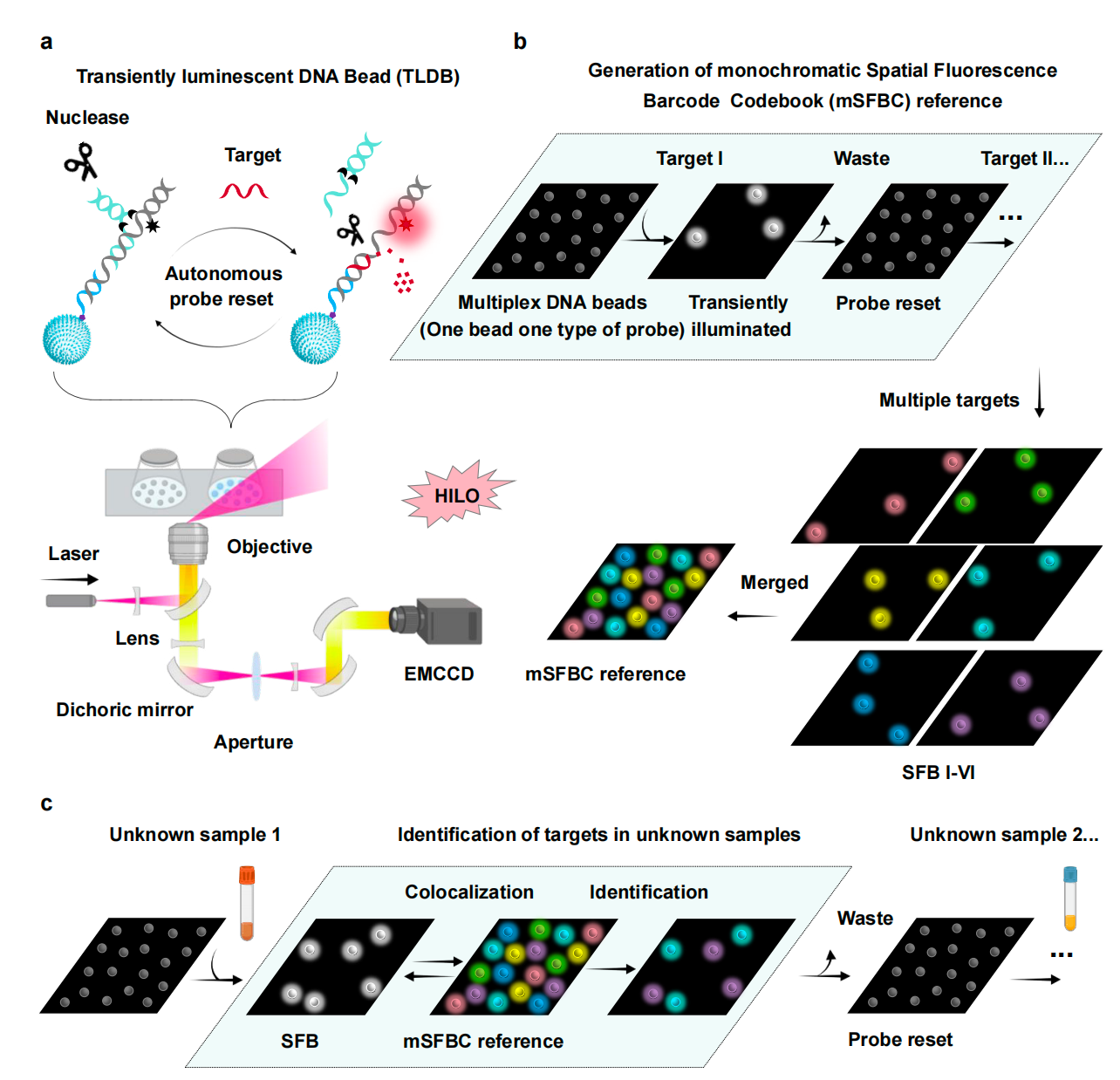
Figure 1: Workflow and principles of the monochrome space fluorescent barcode (SFB) system.
From Principle Validation to Clinical Samples: The Usability of Spatial Barcodes
Focusing on three key issues: "accurate coding, cyclic reuse, and real sample detection," the team systematically verified the performance of the SFB platform. Results showed that the seven DNA microspheres produced a clear fluorescence response only when matched targets were present, with almost no cross-reactivity in the unmatched combination, demonstrating good orthogonality of the system. The Y-shaped probe can undergo multiple rounds of "activation—reset" cycles, and the microsphere spatial position remains stable even after continuous detection; In DNA model target detection, the platform detection limit is about 1 pM.
In application validation, the team used SFB for identifying marker genes for clinically relevant pathogens, covering species-specific and highly virulent genes for various important pathogens. The test results of clinical infection blood samples are consistent with reference sequencing results, and multiple samples can be analyzed in bulk within the same codebook. Furthermore, the team replaced the nuclease module with ExoIII for RNase H, enabling synchronous recognition of multiple miRNA markers in breast cancer tissue, demonstrating SFB's potential in pathogen detection and tumor marker analysis.
"Let the fluorescence only emit light, let the space handle decoding."
The SFB strategy integrates molecular recognition, dynamic DNA reactions, enzymatic remission, and microscopic spatial localization into a single platform, providing a new technological route for future low-cost, scalable multiplex nucleic acid detection.
Paper link:https://doi.org/10.1038/s41467-025-67410-3
Image | Tian Dandan
Manuscript | Tian Dandan
Reviewed by | Jia Guanglian, Wang Xing, Cao Hui