
Membrane separation technology, with its advantages of low carbon footprint and environmental friendliness, has been widely applied in fields such as biomedicine, bioenergy, and food engineering, becoming a crucial technological force in green biomanufacturing. However, membrane structure damage is difficult to avoid in actual separation systems, leading to a continuous decline in separation performance and ultimately reaching the end of its lifespan, resulting in energy and environmental burdens. Traditional methods of waste membrane disposal, such as landfill and incineration, are neither economical nor environmentally friendly; how to reprocess waste membranes to turn waste into treasure is the core challenge in the technological breakthrough of membrane material resource recycling.
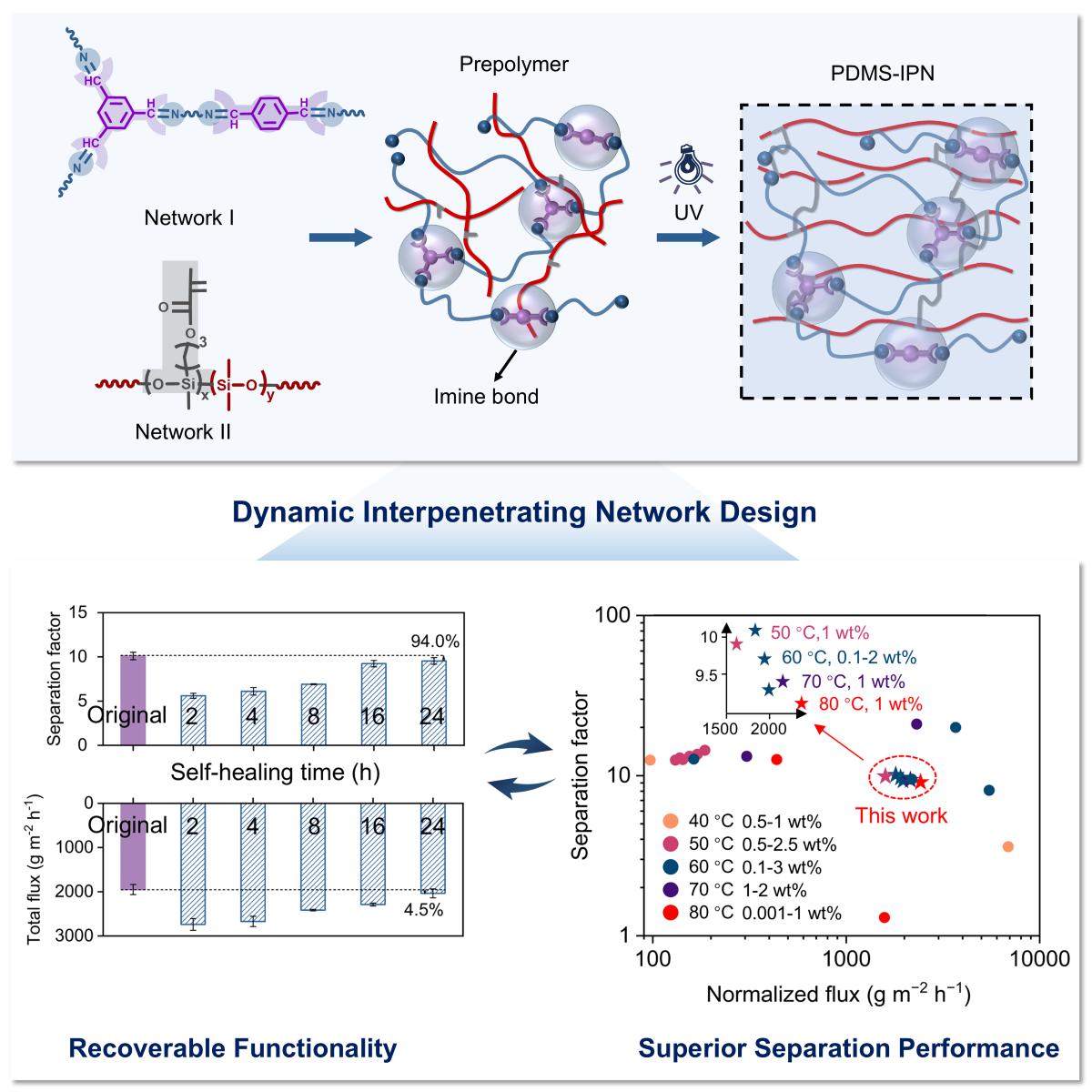
To address the aforementioned challenges, the team of Qin Peiyong and Si Zhihao from the School of Life Science and Technology at Beijing University of Chemical Technology (BUCT), in collaboration with Professor Cao Pengfei from the School of Materials Science and Engineering at BUCT, successfully developed a polymeric membrane material that combines in-situ self-healing properties with excellent separation performance through dynamic homogeneous interpenetrating network design. Based on PDMS, a homogeneous dual network was constructed. Network I, dominated by dynamic imine bonds, endows the membrane with self-healing capabilities, while Network II, functionalized with methacrylate groups, endows the membrane with selective separation capabilities. After damage repair, the elongation at break and tensile strength of the material recovered to 94.5% and 92.4%, respectively, demonstrating excellent dynamic repair characteristics. Using this material to construct a self-healing separation membrane platform, the membrane flux for phenol separation is 3.3 times that of traditional non-dynamic structure membranes; after damage repair, the phenol separation factor recovers to 94.0% of its original value, with flux fluctuation of only 4.5%, demonstrating outstanding membrane defect repair capabilities. Furthermore, the method is simple to operate and has been proven applicable at the membrane module level and in high-temperature, high-concentration, and complex chemical systems. This work provides a new paradigm for the molecular design of next-generation sustainable separation membrane materials. The related paper, titled "Dynamic Interpenetrating Network Design for Polymeric Membranes with Efficient and Recoverable Separation Performance," was published in the Cell sub-journal Matter.
Paper link: https://doi.org/10.1016/j.matt.2026.102942