
Recently, a research paper titled "Caspase forms double-stranded helical assembly during the type IV Thoeris antiviral response" was published in Vita by a team led by Feng Yue from the School of Life Sciences and Technology at Beijing University of Chemical Technology and a team led by Li Ming from the Institute of Microbiology, Chinese Academy of Sciences. This study reveals a novel activation mechanism of caspase-like proteins in the type IV Thoeris antiphage immune system, providing new insights into bacterial antiviral immunity and the functional evolution of caspase-like proteins in different life groups.
Bacteriophages are viruses that specifically infect bacteria. To defend against bacteriophage invasion, bacteria have developed various anti-phage defense systems over a long period of evolution. Among them, the Thoeris system is an important bacterial immune system that generates small-molecule immune signals through TIR domain proteins and activates downstream effector proteins, thereby limiting phage replication and spread. The type IV Thoeris system consists of TIR domain proteins and caspase-like proteins, but how TIR-derived immune signals activate caspase-like proteins, and how this process participates in anti-phage defense, has previously lacked a systematic structural and mechanistic explanation.
In this study, the collaborative team discovered that the type IV Thoeris system is widely present in bacteria and archaea and can help E. coli resist infection by phages such as T6 and EP02SG. The study showed that after phage infection, the TIR protein can utilize intracellular NAD+ to generate the nucleotide signaling molecule N7-cADPR; this signaling molecule further binds to the C-terminal domain of a caspase-like protein, inducing conformational changes and higher-order assembly remodeling. The activated caspase-like protein can cleave multiple intracellular proteins, disrupting basic host cell life activities, thereby blocking phage amplification through an abortion-like infection response.
By combining cryo-electron microscopy structural analysis, biochemical experiments, and phage defense experiments, the research team elucidated the molecular process by which caspase-like proteins transition from a resting to an activated state. In the uninfected state, caspase-like proteins primarily exist as dimers or right-handed helical assemblies, with their substrate channels blocked by key loop regions, resulting in a self-inhibited state. Upon N7-cADPR binding, the caspase dimers reassemble into a double-stranded left-handed helix structure, thereby opening the substrate-binding channel and remodeling the catalytic center, ultimately activating the proteolytic function. This discovery reveals a novel regulatory paradigm different from the classic caspase activation mechanism: nucleotide second messengers activate caspase-like effector proteins by inducing higher-order assembly remodeling.
This study not only elucidated the key molecular mechanisms of the type IV Thoeris antiphage system, but also linked TIR domain-mediated immune signaling and Caspase-like protein-mediated cell fate regulation to the same prokaryotic antiviral pathway, providing important clues for understanding the evolutionary connections of the innate immune system across biological domains.
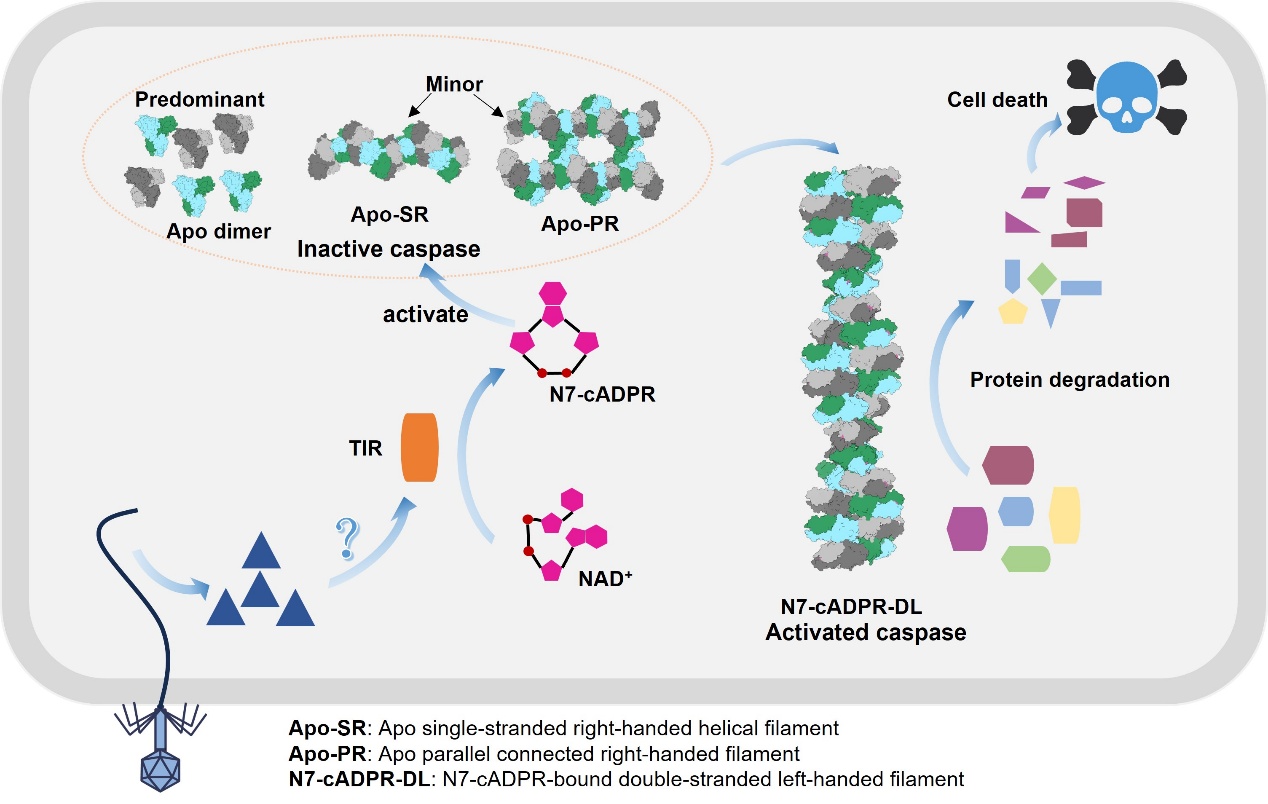
A model of N7-cADPR-dependent activation of caspase-like proteins in type IV Thieris antiphage immunity
Paper link:https://doi.org/10.15302/vita.2026.06.0047
Linlin Wei, a doctoral student at Beijing University of Chemical Technology, Xian Shu, a doctoral student at the Institute of Microbiology, Chinese Academy of Sciences, and Wenhe Wang, a doctoral student at the University of Science and Technology Beijing, are the co-first authors of this paper. Yue Feng, a professor at the School of Life Sciences and Technology, Beijing University of Chemical Technology, Ming Li, a researcher at the Institute of Microbiology, Chinese Academy of Sciences, and Wenhe Wang, a doctoral student at the University of Science and Technology Beijing, are the co-corresponding authors. This research was supported by the National Key Research and Development Program of China, the Strategic Priority Research Program of the Chinese Academy of Sciences, and the National Natural Science Foundation of China.
Feng Yue is a professor and doctoral supervisor at Beijing University of Chemical Technology. He received his Ph.D. from Tsinghua University in 2013 and joined Beijing University of Chemical Technology that same year. For many years, Professor Feng's research group has been using biochemistry and molecular biology, structural biology, and cell biology to study the structure and function of proteins related to the interaction between microorganisms and the host immune system. He has published 36 SCI papers as corresponding author (including co-authors) in journals such as Nature (2018 & 2024), Cell (2023 & 2025), Vita (2026), Mol Cell (2020 & 2022 & 2024), Nat Chem Biol (2022 & 2024 & 2025 & 2026), and PNAS (2023). He has received numerous awards, including National Youth Post Expert (2020), Young Beijing Scholar (2024), the 19th Fok Ying Tung Education Foundation Higher Education Youth Science Award (2024), Beijing Outstanding Young Talent (2020), Second Prize of Chinese Medical Science and Technology Award (2024), one of China's Top Ten Emerging Scientific and Technological Figures (2018), Beijing Science and Technology Star (2019), and Outstanding Instructor Award in the Beijing Higher Education Young Teachers' Teaching Skills Competition (2023).