
To align with major national strategic needs, systematically summarize the achievements in discipline development, analyze shortcomings, and scientifically advance the 15th Five-Year Plan for discipline development, the College of Life Sciences held a discipline development seminar on October 15th in Room 304 of the Science and Technology Building. Vice President Xu Haijun and Director of the Planning Office Yu Le attended the meeting, along with all members of the school's leadership team and relevant faculty members. The meeting was chaired by Dean Tong Yigang.
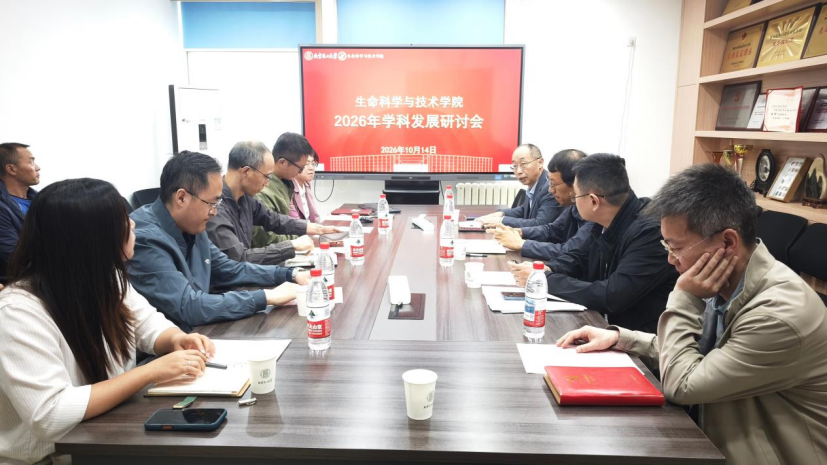
At the meeting, the heads of each discipline reported on the development of their disciplines and exchanged views on discipline foundations, platform conditions, talent teams, research outputs, talent cultivation, and future development plans.
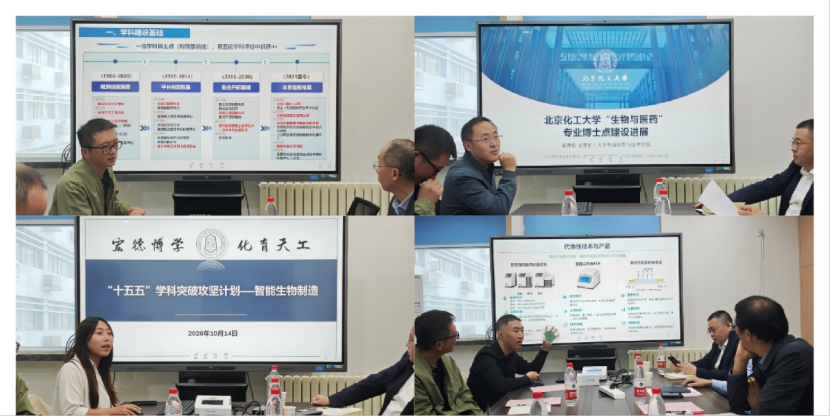
Li Zhengjun reported on the progress of the development of the bioengineering discipline. He introduced the discipline's distinctive advantages in biomanufacturing, industry-university-research collaboration, and international cooperation. He also reviewed existing problems in light of relevant discipline evaluation indicators and stated that the discipline will continue to consolidate its competitive advantages and further strengthen its core competitiveness.
Yu Qingsong reported on the development of the professional master's and doctoral programs in biology and medicine. He reviewed the enrollment scale, training system, and employment quality of the professional master's and doctoral programs, and analyzed the strengths and weaknesses of the discipline's development. The next step will be to continue deepening the integration of industry and education, expand joint training resources in emerging fields, leverage industry alumni resources, and optimize the training model for leading engineering and technical talents.
Luo Shizhong reported on the development of the pharmacy discipline. Based on the existing educational foundation, he analyzed the shortcomings in the development of the discipline's talent pool, and proposed to leverage the college's strengths in biomanufacturing, focusing on the development of pharmaceutical biomanufacturing and AI-driven pharmaceutical research, deepening collaboration with leading industry enterprises, improving hardware platform conditions, and pursuing a differentiated and distinctive development path.
Su Xin reported on the development of the biomedical engineering discipline. The discipline has established major research directions and curriculum systems in micro-nano medicine, biosensing, tissue engineering, and bioinformatics. Relying on the translational research center jointly established with the China-Japan Friendship Hospital, it continues to produce interdisciplinary research results in medicine and engineering. Going forward, it will strengthen collaborative innovation between medicine and engineering, focus on improving its instrument and equipment R&D capabilities, and enhance the recruitment and cultivation of young talents.
Chen Yanchun reported on the development of the interdisciplinary master's program in intelligent biomanufacturing. She explained the strategic significance of establishing the program in light of national industrial development needs, and introduced its main research directions, faculty, and platform infrastructure. The program will improve its dual-mentor training model, build a high-throughput intelligent experimental platform, actively plan for the application of an interdisciplinary doctoral program, and strive to cultivate interdisciplinary innovative talents who deeply integrate biotechnology and artificial intelligence.
After listening to the report, Vice President Xu Haijun delivered a concluding speech. He fully affirmed the achievements of the college's various disciplines, while also pointing out the opportunities and challenges facing the development of these disciplines, and put forward work requirements for the college's future development.
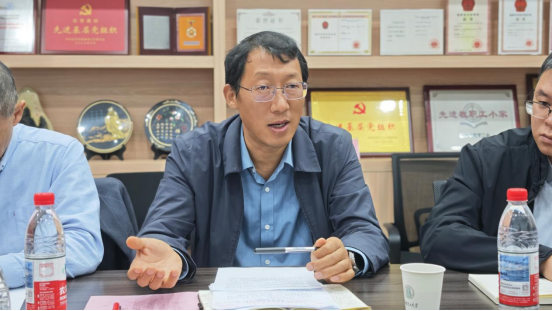
Xu Haijun emphasized that the biotechnology industry is currently undergoing a critical period of rapid transformation. The college must seize the policy window of opportunity, make good use of various special construction resources, and plan the development of disciplines with high standards based on the "four orientations." First, it is necessary to strengthen benchmarking awareness, align with national strategic deployments such as the "Education Powerhouse" and the "15th Five-Year Plan," accurately identify entry points for discipline construction, create distinctive and advantageous directions, and form irreplaceable disciplinary competitiveness. Second, it is essential to solidify interdisciplinary construction, promote deep linkage between discipline construction and talent cultivation, rely on organized scientific research to produce a number of technological achievements verified in actual industrial scenarios, and avoid formalistic, piecemeal interdisciplinary approaches. Third, it is crucial to coordinate the collaborative development of various disciplines, optimize the allocation of resources, revitalize university-enterprise and alumni resources, and form a synergy for construction. Fourth, it is vital to seize the opportunity for talent introduction and increase efforts to attract and cultivate high-level talents and young backbone personnel. Fifth, it is imperative to attach great importance to the evaluation of degree programs and disciplines, maintain a clear understanding, and effectively transform policy opportunities into tangible results in the construction of disciplinary content.
Tong Yigang, representing the college, made a statement. He stated that the college will earnestly implement all the work requirements of this meeting, solidify its responsibilities, overcome difficulties, and strive to promote the high-quality development of all disciplines.
Text and images by: Mi Zhiwei
Reviewed by: Jia Guanglian, Tong Yigang, Cao Hui