
The team of Li Guofeng and Wang Xing from Beijing University of Chemical Technology, in collaboration with the team of Xiao Haihua from Soochow University and other partner institutions, published a paper entitled Perturbation of the Electron Transport Chain by Guanidinium-Based Cationic Polymers Induces Metabolic Collapse in Persister-Enriched Bacterial Populations in Angewandte Chemie International Edition on October 13, 2026.
Bacterial persisters are widely regarded as dormant or hypometabolic cells that survive antibiotic treatment with suppressed metabolic activity. Here, we show that this apparent quiescence is accompanied by a heightened vulnerability to electron transport chain (ETC)-associated perturbation by guanidinium-based cationic polymers. PO3G, a representative polymer, preferentially kills persister-enriched populations while markedly perturbing respiratory electron transfer. Following this ETC-associated perturbation, persister-enriched populations exhibit sustained superoxide-associated oxidative stress and fail to restore NADH/NAD+ homeostasis, leading to progressive loss of viability. Consistent with this ETC dependency, PO3G also markedly reduces persister-enriched population induced by diverse triggers across bacterial species and achieves up to 7-log reductions in bacterial burden in vivo. These results establish a mechanistic link between cationic polymer-induced ETC-associated perturbation and persister elimination, highlighting limited recovery from respiratory and redox perturbation as a vulnerability underlying the preferential killing of persisters.
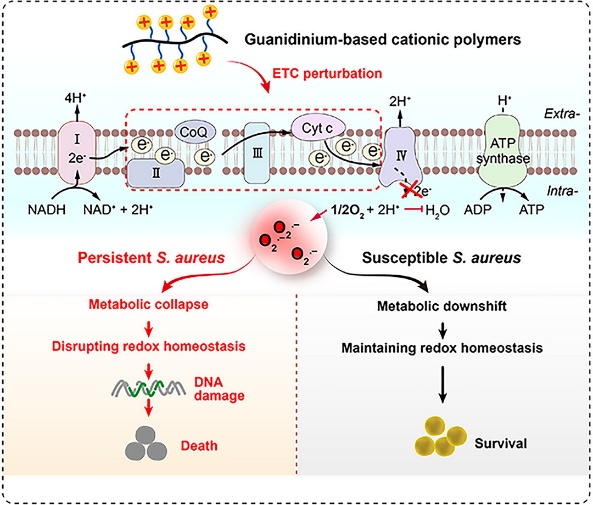
Fig. Guanidinium-based cationic polymers induced electron transport chain perturbations and their effects on bacteria in different physiological states
Paper link:https://doi.org/10.1002/anie.2976200