
The Liu Huiyu’s team from Beijing University of Chemical Technology and the Sun Hongtao’s team from Lanzhou University jointly published a research paper titled Ultrasound-Responsive Piezoelectric Fibrous Membrane Promotes Neurological Recovery After TBI by Modulating Microglial Polarization via Restoring Mitochondrial Dynamic Homeostasis on Advanced Science online on September 21, 2026.
Traumatic brain injury (TBI) represents a significant cause of global disability and mortality in young adults. Current clinical treatments primarily focus on hematoma evacuation and intracranial pressure control during the acute phase. However, effective interventions for secondary brain injury-particularly the neuroinflammatory cascade and oxidative stress damage-remain lacking, often resulting in poor neurological recovery.
Mitochondrial dysfunction is a core pathological mechanism underlying secondary injury following traumatic brain injury, with the resulting oxidative stress and inflammatory cascade being key contributors to neurological deficits and poor clinical outcomes. This study developed an ultrasound-responsive piezoelectric fibrous membrane that, under low-intensity pulsed ultrasound (LIPUS) stimulation, generates controllable piezoelectric signals directly at the injury site to precisely regulate mitochondrial function in microglia. This regulation effectively restores mitochondrial dynamics homeostasis and enhances mitochondrial membrane potential (ΔΨm) stability, significantly suppressing the abnormal generation of mitochondrial superoxide and cellular reactive oxygen species (ROS). It promotes the polarization of microglia toward a neuroprotective M2 phenotype, reduces the expression of pro-inflammatory cytokines TNF-α, IL-1β, and IL-6, and enhances the activity of the antioxidant enzyme superoxide dismutase (SOD). In a TBI animal model, this therapeutic strategy markedly alleviated pathological brain damage, improved neuronal survival, ameliorated neurological deficits and spatial memory impairment, and facilitated the polarization of microglia toward an anti-inflammatory (M2) phenotype in the injured area. This study provides a novel strategy for TBI treatment by targeting mitochondrial function regulation, offering potential to overcome the therapeutic challenges in neuroimmunometabolic modulation.
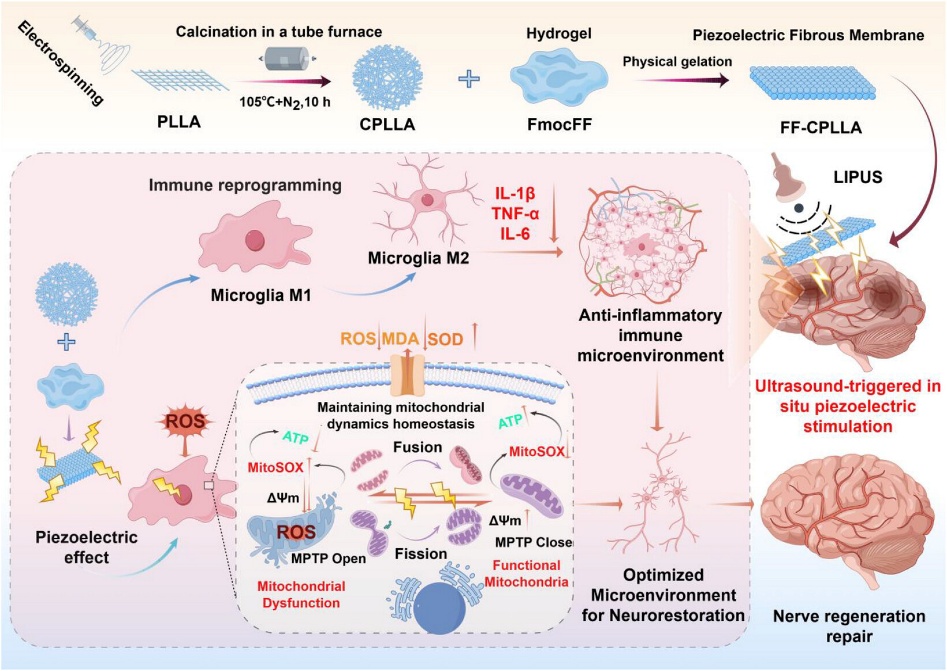
Fig. A piezoelectric fibrous membrane system designed for the treatment following traumatic brain injury (TBI). This system utilizes low-intensity pulsed ultrasound (LIPUS) to drive the in situ generation of controllable piezoelectric signals at the injury site. This process aims to precisely modulate mitochondrial function and the polarization phenotype of microglia, thereby ameliorating the neuroimmune microenvironment. The ultimate therapeutic goals are the attenuation of histopathological damage, enhancement of neuronal survival, and the promotion of neural repair.
Paper link: https://doi.org/10.1002/advs.202600081