
To inherit the spirit of the Great Long March and continue the red bloodline, on the afternoon of October 29, 2026, College of Life Sciences organized faculty and students to watch the red film Crossings at the Golden Rooster and Hundred Flowers Cinema.
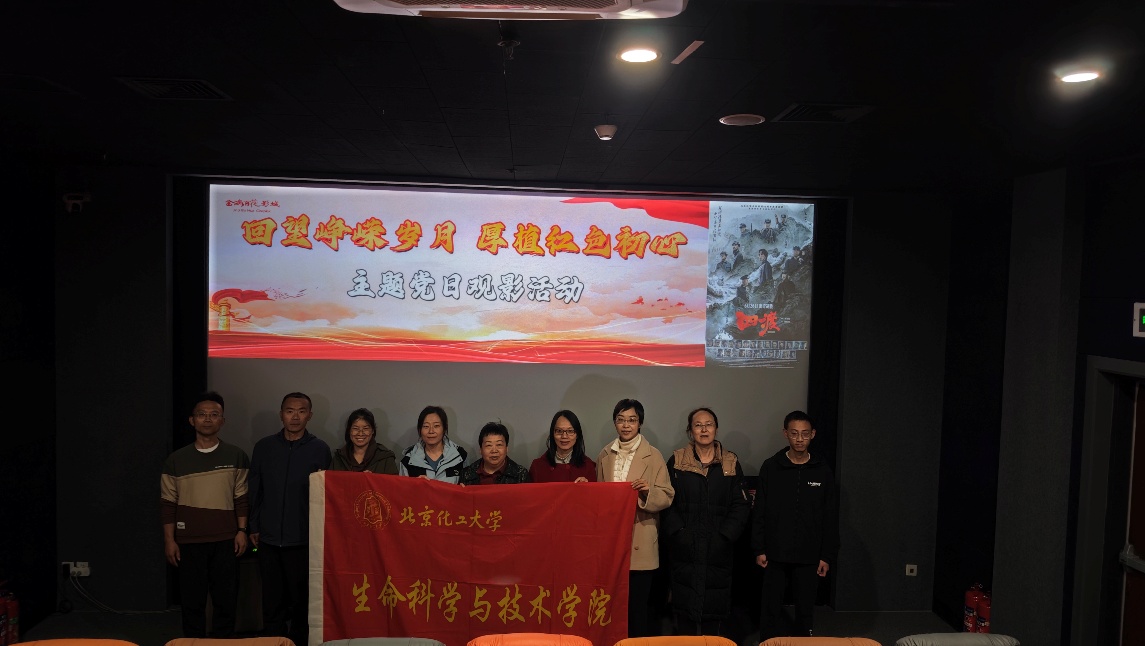
Set against the historical backdrop of the Red Army's four crossings of the Chishui River during the Long March, the film vividly recreates the glorious history of the Red Army's flexible maneuvering and victories against overwhelming odds under extremely difficult conditions. It profoundly showcases the Red Army soldiers' unwavering ideals and beliefs, outstanding military wisdom, and heroic spirit of fearlessness under the leadership of the Communist Party of China. The scenes of Red Army soldiers fighting bravely and valiantly on screen deeply moved the teachers and students in the audience.
After the film screening, everyone generally agreed that peace and happiness are hard-won and should be cherished, with gratitude and dedication. They expressed their intention to use this experience as an opportunity to remember revolutionary history, carry forward the spirit of the Long March, and integrate their patriotism and dedication to the country into their studies and work, striving to perform their duties with firmer conviction and a more pragmatic approach.
Jia Mengqiu: Revisiting the history of the Four Crossings of the Chishui River fills me with awe and admiration. This was a pivotal moment in the Long March, a classic example in military history of defeating a stronger enemy with superior numbers and maneuvering to control the battlefield. Facing an enemy force several times their size, the Red Army soldiers traversed the treacherous mountains and rivers of Sichuan and Guizhou, employing feints and flanking maneuvers to repeatedly break out of the enemy's encirclement and firmly seize the initiative on the battlefield.
Shen Chun: The military miracle of crossing the Chishui River four times tells us that when faced with a powerful enemy and a desperate situation, sticking to routines will only lead to our demise. Only by being realistic, adapting to the situation, taking into account the overall picture, and daring to make choices can we create opportunities from a passive position. This is just as Chairman Mao said: "If you save the land but lose the people, you will lose both the land and the people; if you save the people but lose the land, you will save both the land and the people."
Liu Min: Thirty thousand soldiers faced an enemy force of four hundred thousand, breaking through and achieving victory in a desperate situation. This is a miracle forged by the older generation of revolutionaries based on reality, analysis of the enemy's situation, and reliance on the masses. Confident yet not arrogant, prudent yet not afraid of the enemy, this wisdom of the Chinese people deserves to be passed down forever.
Song Lihua: The victory of the Four Crossings of the Chishui River was not only a victory of command art, but also a victory of ideological unity and mass support. The Baisha Conference resolved the fundamental question of "why we turned back," while the details of the door panels and copper coins remind us that discipline and popular support are the foundation for our ability to hold our ground even after penetrating behind enemy lines. After watching the film, it becomes clearer that the spirit of the Long March is not just a slogan, but the ability to maintain the correct direction amidst uncertainty and create conditions in dire circumstances—a spirit that still holds relevance today.
Dai Qiong: At a critical juncture when the enemy's strength was overwhelming and the situation extremely critical, the Red Army commanders assessed the situation and devised ingenious strategies, while the soldiers, undaunted by sacrifice, fought bravely forward, staging a military miracle of defeating a stronger enemy on the banks of the Chishui River. The Chishui River flowed swiftly and meandered; in this desperate situation, it was unwavering faith, flexible strategies, and the united will of the army and the people that supported the Red Army in finding a way out of dire circumstances. Each generation has its own Long March. Although the smoke of war has long since dissipated, the Red Army's composure and unwavering determination in the face of danger still inspire us to embark on our own Long March.
Ling Tao:Every generation has its own "Chishui River" to cross. The Red Army faced encirclement and suppression; we face the challenges of our studies and lives. The film doesn't convey empty slogans, but rather the resilience to remain clear-headed and forge ahead even in seemingly unsolvable situations. As long as we keep moving forward, there is always a way.
Image: Jia Guanglian
Text: Jia Guanglian
Reviewed by: Lü Xinrui, Yin Jia, Cao Hui